Startup Grants and Funding Programs for Revenue-Stage Startups in India — August 2026
Eight active programs are open for revenue-stage startups in India in August 2026. They offer up to ₹10 crore in credit guarantees, seed funding, and competition prizes, including CGSS, Kerala Seed Fund, and iDEX. Deadlines range from rolling to 30 September 2026.

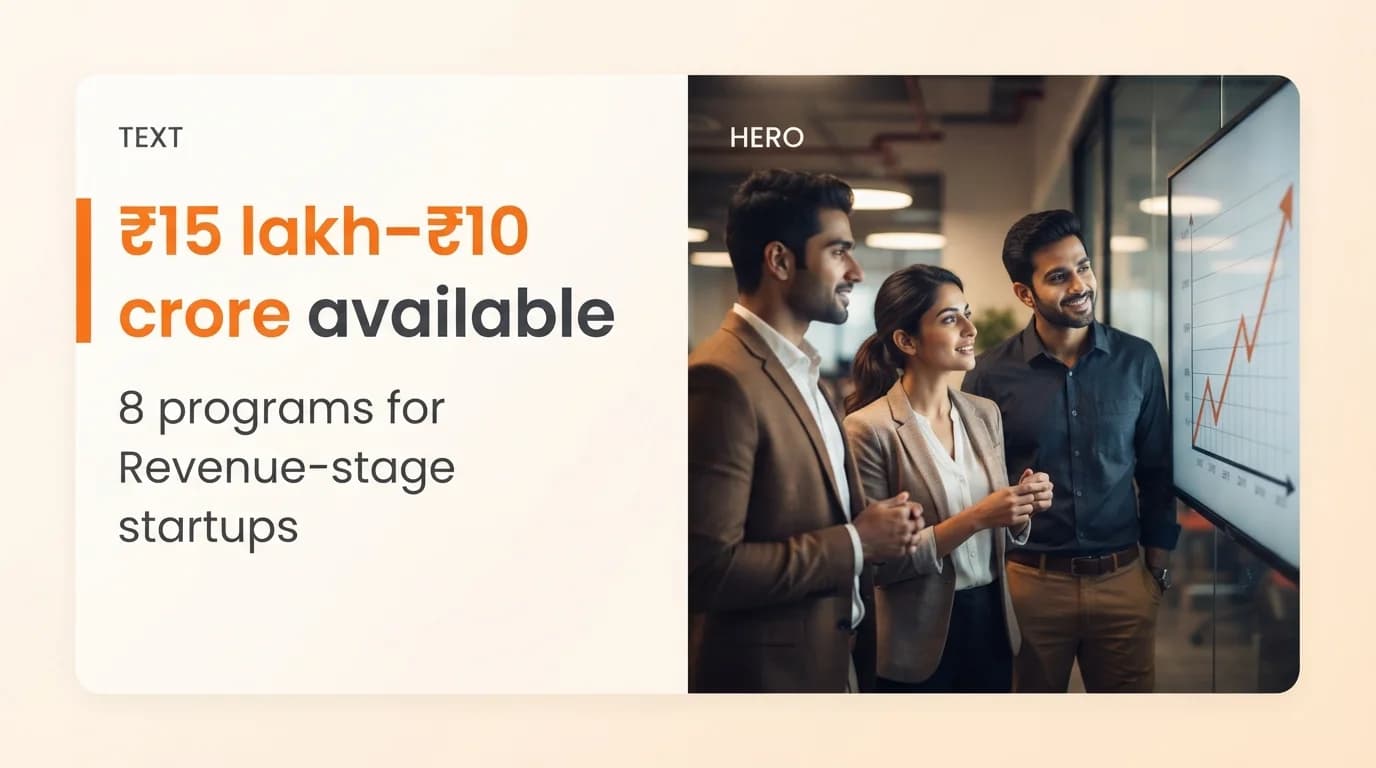
Eight active programs are currently open to revenue-stage startups in India, spanning credit guarantees, state seed funds, sector-specific incubators, and national innovation competitions. Notable among them are the Credit Guarantee Scheme for Startups (CGSS), the Kerala Startup Mission Seed Fund, and the iDEX Open Challenge for defence innovation.
Revenue-stage startups in India typically have a validated product, initial paying customers, and a need to scale customer acquisition and operations. The support on offer reflects that: collateral-free credit guarantees, soft loans against purchase orders, funding from foundations, and cohort-based accelerators. Not all programs have a revenue threshold; rather, eligibility is defined by factors such as DPIIT recognition, state residency, sector focus, or the stage of the business model.
Active Programs for Revenue-Stage Startups
| Program | Type | Deadline | Funding |
|---|---|---|---|
| Credit Guarantee Scheme for Startups (CGSS) | Grant | Rolling | Up to ₹10 crore |
| Seed Fund Scheme | Seed Fund | Rolling | Up to ₹15 lakh |
| Women's Economic Empowerment | Incubation | Rolling | From ₹45 lakh |
| Orbit — AIC T-Hub SpaceTech Incubation Program | Incubation | Rolling | Varies |
| Indian Innovation Icons 2027 | Competition | Rolling | Varies |
| The Vault Bharat — Season 2 | Competition | Rolling | Up to ₹1 crore |
| Swanari TechSprint 4.0: AI for Inclusive Finance | Competition | 15 August 2026 | Varies |
| iDEX Open Challenge | Competition | 30 September 2026 | Up to ₹1.5 crore |
Credit Guarantee Scheme for Startups (CGSS) (DPIIT)
The Credit Guarantee Scheme for Startups (CGSS) provides a credit guarantee to Member Institutions against loans extended to DPIIT-recognised startups. The scheme is designed to facilitate collateral-free debt for startups that have reached a stable revenue stage and are amenable to debt financing. Guarantee cover can be transaction-based or umbrella-based for SEBI-registered AIFs.
For revenue-stage startups, the scheme addresses the common barrier of collateral requirements when seeking working capital or expansion loans. Because the guarantee reduces lender risk, startups with steady cash flows but limited tangible assets can access debt up to ₹10 crore. Eligibility is tied to DPIIT recognition, which requires a scalable business model and using technology or intellectual property. The application is made through participating lenders, not directly to the government.
This program suits startups with a few years of operational history, consistent revenue, and a clear repayment plan. It does not provide upfront grant money; it makes debt easier to obtain. The rolling nature of the scheme means startups can apply at any time, provided they first secure a loan from a Member Institution.
Seed Fund Scheme (Kerala Startup Mission)
The Seed Fund Scheme under the Kerala Startup Mission (KSUM) provides up to ₹15 lakh as a soft loan against purchase orders. The interest rate is 6% simple interest per annum. The scheme is aimed at early-stage startups in Kerala, helping them execute orders and manage cash flow.
For revenue-stage startups, this is effectively working capital financing tied to confirmed orders. It is suited for businesses that have started generating sales but need funds to fulfil larger orders. KSUM, as a state government body, also offers mentorship and infrastructure support. Eligibility requires the startup to be registered in Kerala and involved in an innovative, technology-driven business.
Unlike an equity investment, the loan does not dilute founder ownership. The rolling deadline allows applications throughout the year, although approval depends on the startup's order book and KSUM's assessment. Startups that have moved beyond the idea stage and have purchase orders in hand are the primary beneficiaries.
Women's Economic Empowerment (IIMA Ventures)
The Women's Economic Empowerment program is an AI and innovation initiative led by IIMA Ventures with support from the Gates Foundation. It targets technology-enabled solutions that can enhance economic outcomes for women in India. The program offers funding from ₹45 lakh, along with IIMA's incubation resources.
This initiative is suited for revenue-stage startups that have a working product and early adoption, but need scale support. Because it focuses on AI and women's economic empowerment, eligible startups range from fintech for SHGs to platforms for female entrepreneurs. The Gates Foundation's backing indicates a long-term commitment to measurable impact.
The application window is rolling, and shortlisted startups will be taken through IIMA Ventures' acceleration process. Startups with existing revenue and a clear path to impact will be better positioned to demonstrate potential.
Orbit — AIC T-Hub SpaceTech Incubation Program (T-Hub)
Orbit is AIC T-Hub's dedicated SpaceTech incubation program, run from Hyderabad. It is one of India's first sector-specific SpaceTech incubators, taking startups from idea or proof-of-concept through commercialization across satellite technology, spacecraft, orbital launch vehicles, space communication, space materials, space tourism, and uplink/downlink infrastructure.
The 24-week structured curriculum runs in three phases: Assess (weeks 1–4) covering company structure, idea validation, founder mindset, milestones, and business model; Learn (weeks 5–20) with talks on government initiatives, the global space market, low-cost manufacturing, and workshops on India space policy, legal and compliance, and financial modeling. A third phase focuses on business development and investor connections, though specific details were not disclosed.
Revenue-stage startups in the space sector can use this program to refine their product for commercial customers and approach government and private buyers. T-Hub's network and infrastructure add value beyond the curriculum. The application is rolling, but given the intense structure, intake is likely cohort-based. Startups with an existing customer base or successful pilot will find the program most useful.
Indian Innovation Icons 2027 (Marico Innovation Foundation)
The Indian Innovation Icons program is a biennial platform by the Marico Innovation Foundation to identify and support India's most significant innovations. Now in its 11th edition for 2027, the program helps founders with strategic mentorship, investor access, business connections, and national visibility. It welcomes both for-profit and not-for-profit organisations.
For revenue-stage startups, this competition is a way to gain credibility and tap into Marico's corporate network. The selection process is rigorous, and winners often receive media coverage and introductions to later-stage investors. Because it is biennial, skipping this intake means a two-year wait.
The application window is rolling in the sense that no deadline is specified, but the program itself has a fixed cycle. Startups across sectors — from healthcare to agriculture to clean energy — are eligible if they demonstrate substantial innovation with measurable impact. Revenue-stage companies with proven pilots will be more compelling applicants.
The Vault Bharat — Season 2 (—)
The Vault Bharat — Season 2 is one of India's startup reality shows, back for a second season with an Uttar Pradesh focus. Founders based in UP across any industry can pitch live on television to a panel of veteran-entrepreneur investors for funding of up to ₹1 crore per startup, along with mentorship and on-screen visibility. Season 1 saw over 100 startups pitch.
Eligibility requires an office address in Uttar Pradesh. All sectors and stages are welcome — from early idea to scaling business. For revenue-stage startups, this is a fast route to patient capital and national exposure, provided the founders are comfortable presenting financials and fundraising details on camera.
The application process is rolling until the show's producers close the submission window. Because it is a filmed production, the selection is cohort-based and has set shoot dates. Startups with existing traction can use this platform to reach investors beyond the traditional VC circuit.
Swanari TechSprint 4.0: AI for Inclusive Finance (IIMA Ventures)
The Swanari TechSprint 4.0 is an innovation challenge co-created by RBIH and IIMA Ventures. It focuses on applying artificial intelligence to improve financial services for women's Self-Help Groups (SHGs), Sakhis, and women entrepreneurs across India. The goal is to create secure, scalable fintech solutions that address gaps in credit access, savings, and digital bookkeeping.
This is a competition with a deadline of 15 August 2026. Revenue-stage startups working on fintech, AI, or digital inclusion can apply, provided they can demonstrate a working solution. The program is more than a contest — it aims to build a foundational infrastructure for capacity building and financial inclusion.
Given the short timeline, startups must be ready to submit a detailed proposal quickly. Winners are likely to receive pilot opportunities with RBIH's network and possible incubation support from IIMA Ventures. This is a targeted opportunity for startups already serving SHGs or adjacent segments.
iDEX Open Challenge (iDEX)
The iDEX Open Challenge is a flagship initiative by the Defence Innovation Organisation (DIO) and iDEX to foster innovation in defence and aerospace. It targets startups, MSMEs, and individual innovators working on autonomous systems, intelligent machines, advanced materials, predictive algorithms, and rocket engines. The goal is to develop products that strengthen national security.
Funding of up to ₹1.5 crore is available, with the deadline set for 30 September 2026. The challenge evaluates innovations against both commercial viability and military utility. Revenue-stage startups in deep tech, manufacturing, or software can apply, but they need to meet technical milestones and likely undergo prototype evaluation.
The program has a structured selection process: applications are screened, shortlisted teams may be asked to pitch, and winners receive a contract to develop their solution. Startups with existing prototypes and early revenue will be better positioned to move quickly through the stages. Because the defence procurement cycle is long, the grant money is meant to accelerate development.
Before Applying
Before applying, review the eligibility constraints that vary across these programs. The Credit Guarantee Scheme requires DPIIT recognition, while The Vault Bharat is limited to startups with an office address in Uttar Pradesh. Orbit is sector-specific to space technology, and Swanari TechSprint focuses on AI solutions for financial inclusion among SHGs. The Indian Innovation Icons accepts both for-profit and not-for-profit entities, but it runs only once every two years.
Timing is also a factor. Swanari TechSprint closes on 15 August 2026 — within days — and expects a detailed submission. The iDEX Open Challenge follows on 30 September 2026. Several other programs have rolling deadlines, but cohort-based intakes mean applications are reviewed in batches. For instance, Orbit's 24-week programme has fixed start dates, and The Vault Bharat's filming schedule dictates the selection window. Missing a cohort can mean waiting several months, or two years in the case of Indian Innovation Icons.