Next 7 days
Startup Grant Calendar
Grant funding in India runs on deadlines. Government schemes, incubator and accelerator cohorts, state startup programmes and corporate CSR challenges each open and close their application windows on their own schedule — and a founder who finds a perfect-fit programme a day after it closes has to wait for the next cycle, which can be months away. This calendar pulls those dates into one place so you can see what is closing, and what is opening, across the Indian startup funding landscape at a glance.
Your grant application copilot.
One workspace for every grant — matched to your startup, tuned to each program.
Tomorrow
1 programSaturday, 10 Oct
3 programs2
days
Competition
Hefty-Hacks
by TechZap
A fully-online Finance × Trading hackathon by TechZap — ₹75,000 prize pool, Azure credits, and direct hiring rounds for top teams.
Upto ₹75,000
2
days
Competition
AWS × IDFC × Campus Fund Grand Challenge 2026
by Campus Fund
7th edition of India’s biggest student-startup competition (AWS × IDFC × Campus Fund) — get noticed, meet investors, and pitch at the Mumbai Grand Finale.
2
days
Competition
PaymentsNext
by AIC ISB
PaySprint × AIC ISB innovation challenge for MVP to growth-stage startups building intelligent payments infrastructure. ₹7.5L prize pool in cash and credits. Deadline 10 October 2026.
₹1.5L–₹3.5L

Sunday, 11 Oct
1 program3
days
Competition
Together 7.0 Indo-Canada Bootcamp & Pitch
by Schulich School of Business, York University
An Indo-Canada initiative empowering student entrepreneurs and recent graduates to build innovative solutions for India through an intensive bootcamp and pitch competition with cash prizes up to ₹10.5 lakhs.
Upto ₹10.5L
Monday, 12 Oct
2 programsThursday, 15 Oct
13 programs7
days
Grant
Med-Tech Launcher Program 2026
by UP Promote Pharma Council (UPPPC)
A mission-driven accelerator initiative by the UP Promote Pharma Council for late-stage MedTech innovations (TRL 7-9) to bridge the gap from validated prototypes to full-scale market deployment and commercialization.
7
days
Fellowship
Anandi Fellowship by Bombay Shaving Company 2026
by Bombay Shaving Company
A unique fellowship for 11th, 12th, and 1st-year UG students offering annual scholarships, summer internships with stipends, a PPO, and potential ₹1 crore seed investment for their startup.
₹1L–₹1Cr
7
days
Competition
Youth Entrepreneurs Challenge 2027
by Ministry of Youth Affairs & Sports, Government of India
A national competition inviting young innovators, startup founders, and working professionals to develop impactful solutions and compete for cash prizes up to ₹1.5 lakh.
₹30,000–₹1.5L
7
days
Competition
Tamil Nadu Tourism Innovation Challenge 2026
by StartupTN
A challenge by Tamil Nadu Tourism and StartupTN inviting startups and innovators to develop tech-driven, sustainable solutions for the future of tourism in Tamil Nadu.
7
days
Fellowship
SARTHI AIC-ADT Baramati Incubation 2026
by AIC-ADT Baramati Foundation
A year-long Entrepreneurs-in-Residence (EiR) incubation program for Maratha and Kunbi entrepreneurs with scalable Agri-Tech ideas in Maharashtra, offering a monthly fellowship grant.
Upto ₹3L
7
days
Fellowship
SARTHI AIC-MIT ADT Incubation 2026
by AIC MIT ADT Incubator Forum
A year-long incubation in Maharashtra for Maratha and Kunbi community founders with Deep-Tech, Agritech, EV, IoT, AI/ML or Renewable Energy ideas, with a ₹25,000 monthly fellowship and mentorship.
Upto ₹3L
7
days
Fellowship
SARTHI-SUKRDF Incubation Program 2026-2027
by SUK Research and Development Foundation (SUKRDF)
12-month incubation with a ₹25,000 monthly fellowship for Maratha and Kunbi entrepreneurs in Maharashtra with technology-based business ideas.
Upto ₹3L
7
days
Fellowship
SARTHI-Raisoni GHRTBI Incubation 2026
by G.H. Raisoni Technology Business Incubator Foundation (GHRTBI)
Incubation for Maratha and Kunbi entrepreneurs in Maharashtra with technology-based ideas: ₹25,000 monthly fellowship, co-working space, labs and mentorship.
Upto ₹3L
7
days
Grant
SARTHI x MAGIC Incubation 2.0
by Marathwada Accelerator for Growth & Incubation Council (MAGIC)
Incubation program from MAGIC and SARTHI for aspiring entrepreneurs and early-stage startups, with mentorship, capacity building and networking.
Upto ₹3L
7
days
Grant
SARATHI-Uddyam Solapur Incubation Batch 3
by UDDYAM PAHSUI FOUNDATION
An incubation program providing space, mentorship, and networking for innovators from Maratha, Kunbi, and Maratha-Kunbi communities in Maharashtra focusing on Agritech, Renewable Energy, and Food Tech.
Upto ₹3L
7
days
Grant
SARTHI SPPU Research Park Foundation Incubation 2026-27
by SPPU Research Park Foundation
A one-year SARTHI incubation for Maharashtra entrepreneurs with a technology business idea, with a ₹25,000 monthly stipend. 10 join each centre.
Upto ₹3L
Tomorrow
1 programSaturday, 10 Oct
3 programs2
days
Competition
Hefty-Hacks
by TechZap
A fully-online Finance × Trading hackathon by TechZap — ₹75,000 prize pool, Azure credits, and direct hiring rounds for top teams.
Upto ₹75,000
Sunday, 11 Oct
1 program3
days
Competition
Together 7.0 Indo-Canada Bootcamp & Pitch
by Schulich School of Business, York University
An Indo-Canada initiative empowering student entrepreneurs and recent graduates to build innovative solutions for India through an intensive bootcamp and pitch competition with cash prizes up to ₹10.5 lakhs.
Upto ₹10.5L
Monday, 12 Oct
2 programsThursday, 15 Oct
13 programs7
days
Grant
Med-Tech Launcher Program 2026
by UP Promote Pharma Council (UPPPC)
A mission-driven accelerator initiative by the UP Promote Pharma Council for late-stage MedTech innovations (TRL 7-9) to bridge the gap from validated prototypes to full-scale market deployment and commercialization.
7
days
Fellowship
Anandi Fellowship by Bombay Shaving Company 2026
by Bombay Shaving Company
A unique fellowship for 11th, 12th, and 1st-year UG students offering annual scholarships, summer internships with stipends, a PPO, and potential ₹1 crore seed investment for their startup.
₹1L–₹1Cr
7
days
Competition
Youth Entrepreneurs Challenge 2027
by Ministry of Youth Affairs & Sports, Government of India
A national competition inviting young innovators, startup founders, and working professionals to develop impactful solutions and compete for cash prizes up to ₹1.5 lakh.
₹30,000–₹1.5L
7
days
Competition
Tamil Nadu Tourism Innovation Challenge 2026
by StartupTN
A challenge by Tamil Nadu Tourism and StartupTN inviting startups and innovators to develop tech-driven, sustainable solutions for the future of tourism in Tamil Nadu.
7
days
Fellowship
SARTHI AIC-ADT Baramati Incubation 2026
by AIC-ADT Baramati Foundation
A year-long Entrepreneurs-in-Residence (EiR) incubation program for Maratha and Kunbi entrepreneurs with scalable Agri-Tech ideas in Maharashtra, offering a monthly fellowship grant.
Upto ₹3L
7
days
Fellowship
SARTHI AIC-MIT ADT Incubation 2026
by AIC MIT ADT Incubator Forum
A year-long incubation in Maharashtra for Maratha and Kunbi community founders with Deep-Tech, Agritech, EV, IoT, AI/ML or Renewable Energy ideas, with a ₹25,000 monthly fellowship and mentorship.
Upto ₹3L
7
days
Fellowship
SARTHI-SUKRDF Incubation Program 2026-2027
by SUK Research and Development Foundation (SUKRDF)
12-month incubation with a ₹25,000 monthly fellowship for Maratha and Kunbi entrepreneurs in Maharashtra with technology-based business ideas.
Upto ₹3L
7
days
Fellowship
SARTHI-Raisoni GHRTBI Incubation 2026
by G.H. Raisoni Technology Business Incubator Foundation (GHRTBI)
Incubation for Maratha and Kunbi entrepreneurs in Maharashtra with technology-based ideas: ₹25,000 monthly fellowship, co-working space, labs and mentorship.
Upto ₹3L
7
days
Grant
SARTHI x MAGIC Incubation 2.0
by Marathwada Accelerator for Growth & Incubation Council (MAGIC)
Incubation program from MAGIC and SARTHI for aspiring entrepreneurs and early-stage startups, with mentorship, capacity building and networking.
Upto ₹3L
7
days
Grant
SARATHI-Uddyam Solapur Incubation Batch 3
by UDDYAM PAHSUI FOUNDATION
An incubation program providing space, mentorship, and networking for innovators from Maratha, Kunbi, and Maratha-Kunbi communities in Maharashtra focusing on Agritech, Renewable Energy, and Food Tech.
Upto ₹3L
7
days
Grant
SARTHI SPPU Research Park Foundation Incubation 2026-27
by SPPU Research Park Foundation
A one-year SARTHI incubation for Maharashtra entrepreneurs with a technology business idea, with a ₹25,000 monthly stipend. 10 join each centre.
Upto ₹3L
That's the free preview
That's your free preview of 20 programs. Sign up free to keep browsing and save the grants that fit your startup.
- Keep browsing beyond the preview
- Save grants and pick up where you left off
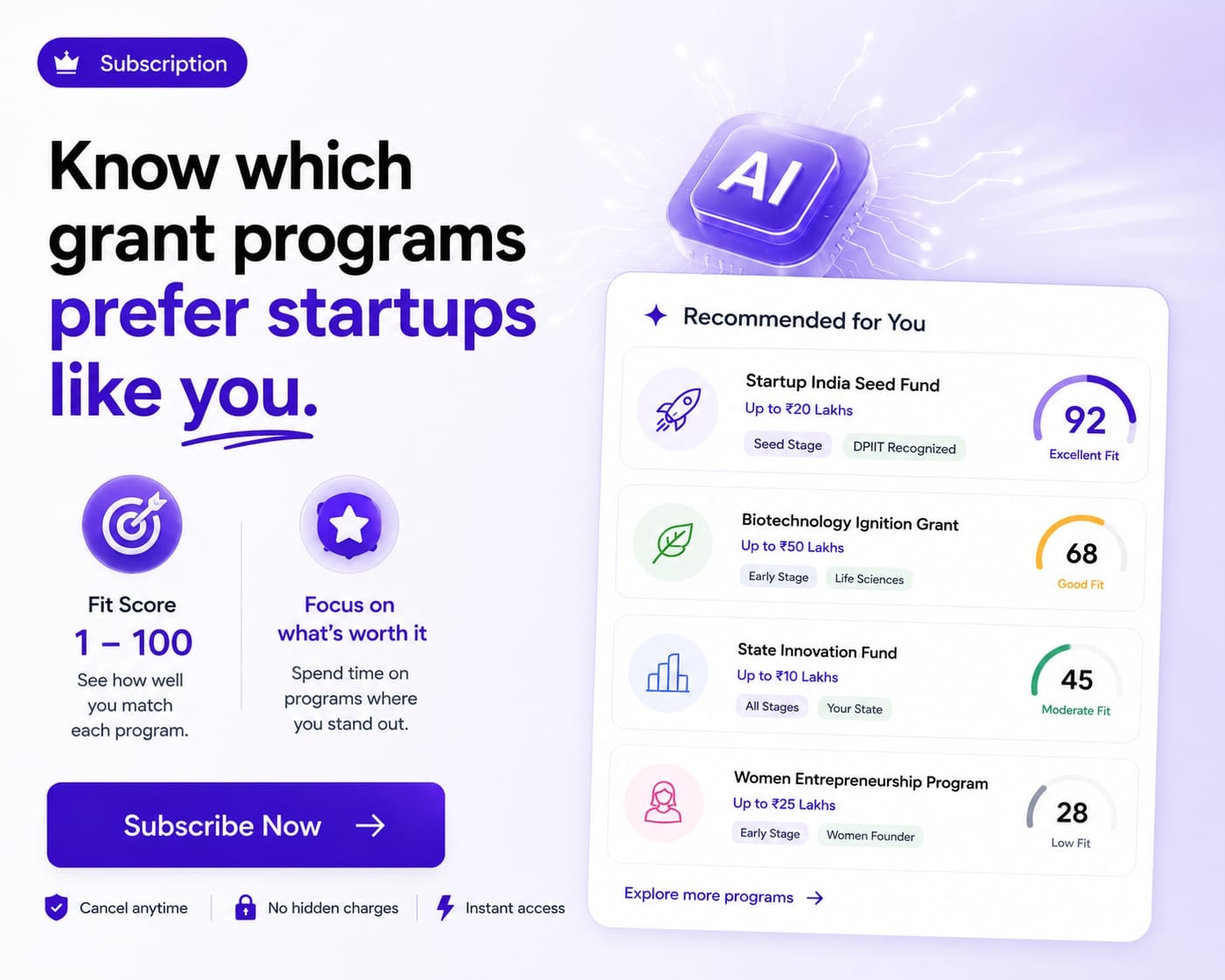
- Get grant matches for your startup
- Deadline reminders so you never miss a grant
Month view
This week is live. Days with a close later — unlock Premium to see which grants and get reminders.
October 2026
Sun
Mon
Tue
Wed
Thu
Fri
Sat
27
28
29
30
1
2
3
4
5
6
7
8
13
14
1
2
3
4
5
6
7
More closing beyond this week — locked
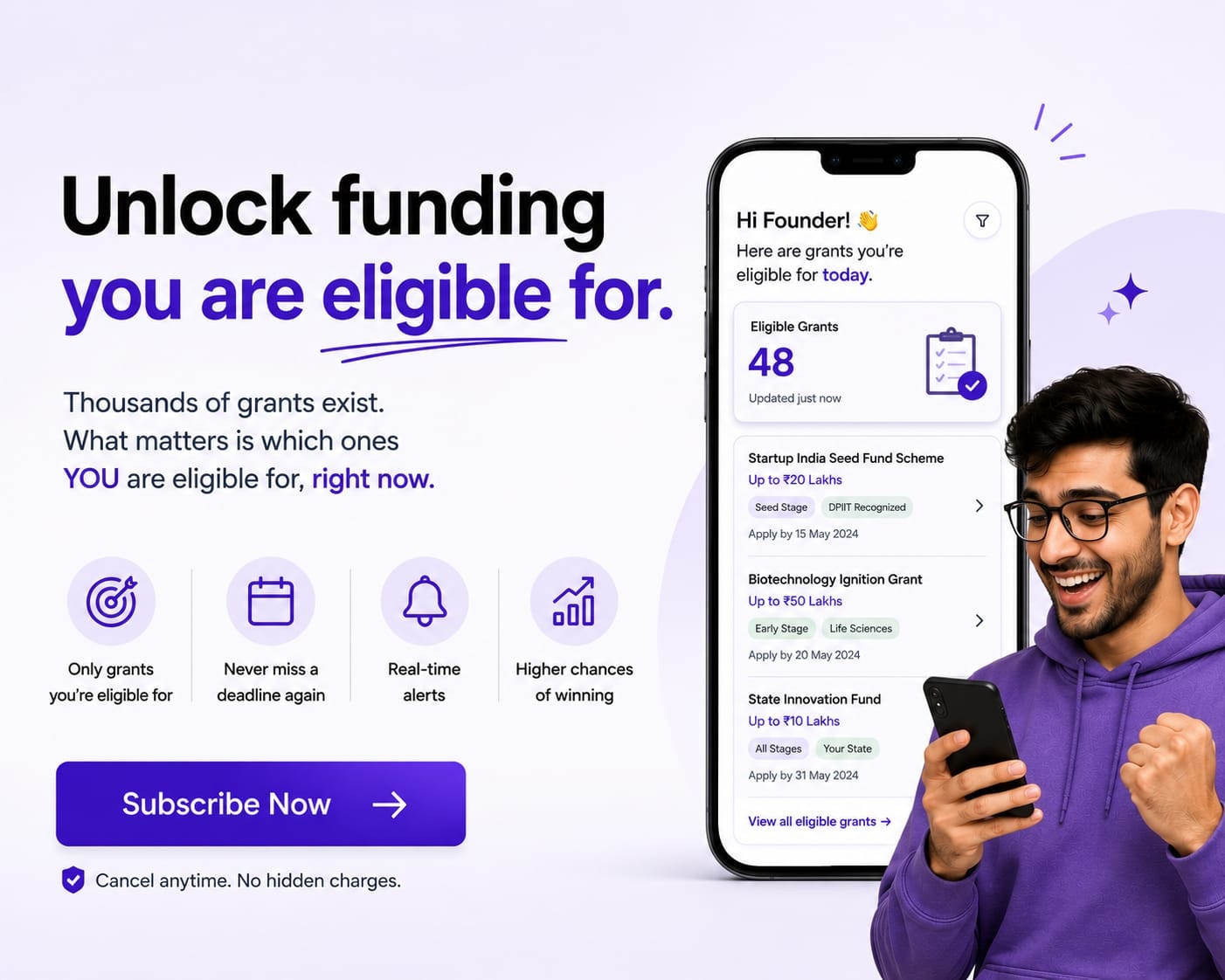
How to use the grant calendar
- 1Scan the next seven days
The agenda groups programmes by day — Today, Tomorrow, then each date this week. A red dot marks an application closing; an amber dot marks a window opening. Start at the top: those are the most urgent.
- 2Open anything that fits
Tap a programme to read its full page — who it is for, how much it offers, the eligibility criteria, and the application link. Confirm you qualify before you start; a grant you are ineligible for is not a deadline worth chasing.
- 3Add it to your own calendar
Use the add-to-calendar button on any entry to drop the deadline into Google Calendar, Outlook or an .ics file for Apple Calendar — with a reminder, so it does not slip.
- 4Come back weekly
New cohorts and schemes are added continuously and windows rotate, so the seven-day view changes. A quick weekly check is the cheapest way to never miss a fit.
How grant and cohort deadlines work in India
Indian startup funding programmes fall into a few broad shapes when it comes to timing, and knowing which one you are looking at tells you how much urgency a date really carries. The first shape is the fixed-deadline call: a programme announces a single cut-off, accepts applications until that date, and then closes to evaluate a batch together. Many central government schemes, grand challenges and CSR-funded programmes run this way. For these, the deadline is hard — miss it and the next opportunity is the following cycle.
The second shape is the rolling window. Here there is no single cut-off; the programme accepts applications continuously and reviews them in batches or as they arrive. A large share of incubator and accelerator intakes, and several government seed and prototype-support schemes delivered through a network of host institutes, work on a rolling basis. Rolling programmes are more forgiving, but they still reward early applicants — batches fill, and reviewers see stronger, earlier applications first.
The third shape is the cyclical or cohort-based intake. Accelerators in particular run in defined cohorts — an intake opens, runs for a fixed number of weeks, and a new cohort opens later in the year. State startup missions often mirror this with annual or twice-yearly cycles tied to their policy calendar. For these, the useful date is often when the next window opens, not just when it closes, because planning a strong application takes weeks.
What this calendar covers
Two kinds of dates appear in the agenda. An application-close entry — shown as "Application closes" — is the last day to submit for a programme whose window is ending within the next seven days. An intake-open entry — shown as "Applications open" — flags a programme whose window is about to begin, so you can prepare rather than scramble. Both are drawn from the same curated catalogue of grants, schemes and cohorts that powers the rest of Startup Grants India.
The seven-day horizon is deliberate. A calendar is only useful if the dates on it are real and current, and a short, live window keeps the agenda honest and actionable rather than a wall of distant dates you will forget. If a week looks quiet, that is normal — much of Indian startup funding is rolling or opens on a longer cycle, so the concentrated fixed-deadline activity in any given week is modest. The programmes that are always open still exist; they simply do not need a countdown.
Because programmes are added and updated continuously, treat the agenda as a snapshot of this week rather than an exhaustive register of every deadline that will ever exist. When you find a fit, open its page and verify the date and eligibility against the programme's own source — deadlines occasionally get extended, and a programme's official page is always the final word.
Why founders miss deadlines — and how to avoid it
The most common reason a founder misses a grant is not that the deadline was hidden; it is that they discovered the programme too late to prepare a credible application. Strong applications need a clear problem statement, a founder and team profile, financials or a budget, and often a pitch deck or prototype evidence — none of which can be assembled well in a single evening. The fix is to separate discovery from application: use a calendar to spot fits early, then work backwards from the deadline to give yourself weeks, not hours.
The second reason is context-switching cost. Founders are busy, and a deadline three weeks out loses to whatever is on fire today — until it is suddenly tomorrow. The antidote is a reminder that reaches you where you already work. That is why every entry here has an add-to-calendar button: put the deadline in the same calendar as your investor calls and product reviews, set it a few days early, and let the reminder do the remembering.
The third reason is chasing the wrong programmes. Every application you start that you were never eligible for is time taken from one you could have won. Before you commit, check the core gates — stage, sector, entity type, state, and whether the programme needs DPIIT recognition, MSME registration or a specific incubator affiliation. A quick eligibility read at the start protects the hours you would otherwise spend on a form you cannot submit.

Planning further than a week ahead
This public calendar is scoped to the next seven days on purpose, but real fundraising planning happens over months. If you are tracking several programmes across different cycles — a seed grant closing this quarter, an accelerator whose next cohort opens after monsoon, a state challenge tied to an annual policy window — you need a forward view that spans them all, with your own reminders and milestones layered on top.
That longer view, together with a personalised shortlist of the grants you are actually eligible for and alerts when new matching programmes are added, is what a Startup Grants India account is built for. The seven-day agenda here is the public, always-open front door; the full forward calendar is where serious, multi-month grant planning lives.
Frequently asked questions
Grants closing soon
See all grants →Hefty-Hacks
by TechZap
Startup perks & credits
See all perks →
Cloud • 12mo validity
₹20,905₹10,452.50
Hostinger Unlimited for 1 year. Official price ₹20,905 — SGI price ₹10,452.50. Leave your name and number and we call within one working day to complete payment.
50% off
Learn more
AI • 12mo validity
₹19,584₹9,792
Manus Pro for 1 year. Official price ₹19,584 — SGI price ₹9,792. Leave your name and number and we call within one working day to complete payment.
50% off
Learn more
SaaS
Up to ₹5L in free Notion AI credits for new startups. Claim with a work email on a new Notion account — AI writing, meeting notes, and research included.

AI • 12mo validity
₹54,144₹25,000
Higgsfield Plus (1,200 credits per month) for 1 year. Official price ₹54,144 — SGI price ₹25,000. Leave your details and we call within one working day to complete payment.
54% off
Learn more