Startup Grants and Funding Programs for Product-Stage Startups in India — October 2026
Product-stage startups in India with a working MVP but no revenue can access a range of funding. As of October 2026, eight distinct programs offer grants, seed investments, and incubation support. These opportunities are tailored to help startups develop, scale, and achieve market entry.

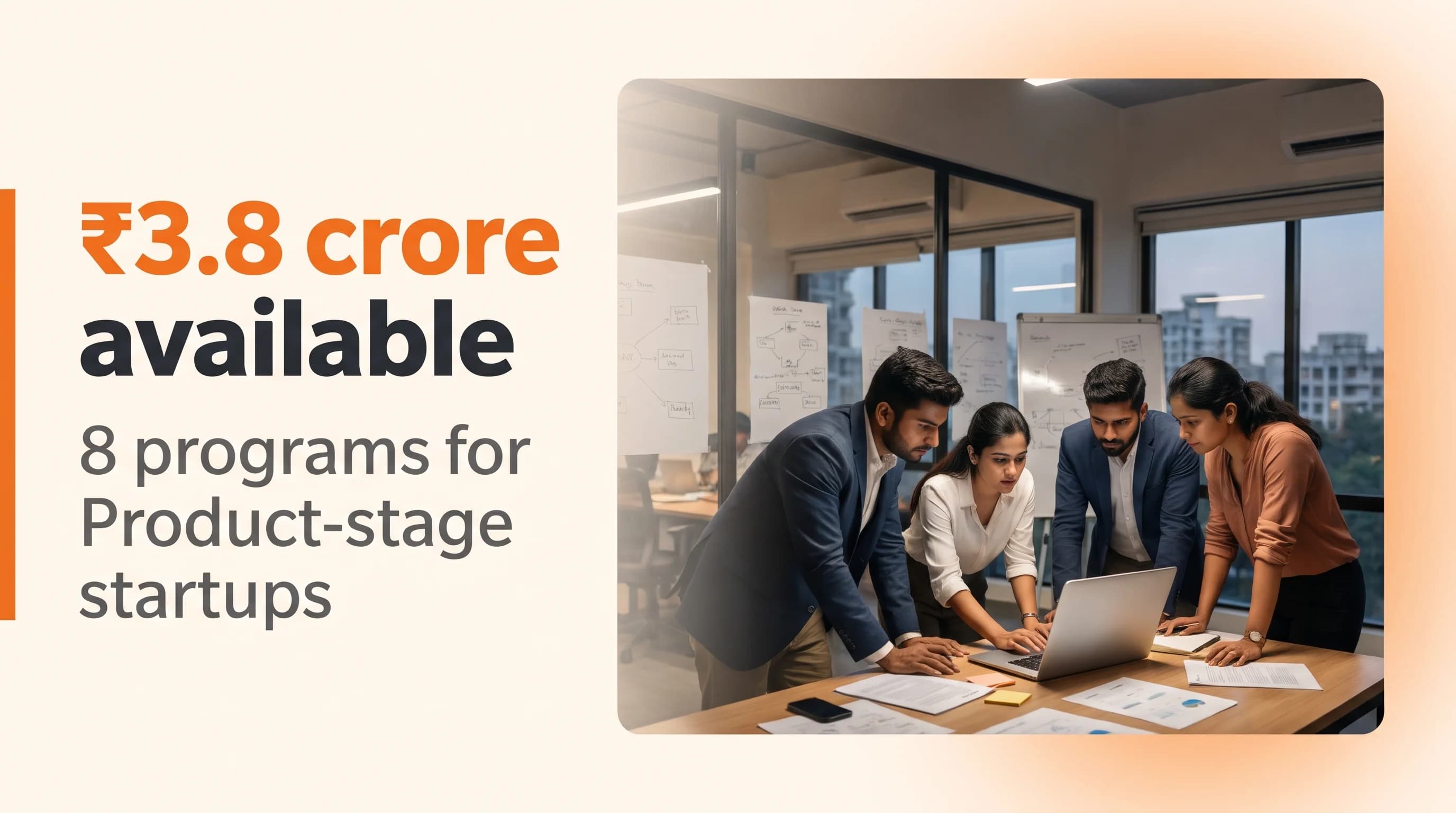
As of October 2026, eight distinct funding programs are currently available for product-stage startups in India, encompassing grants, seed funds, incubation programs, and global competitions. Notable opportunities include the EXIM Bank – SINE Seed Fund Programme, the Hello Tomorrow Challenge 2026, and the Villgro Climate Tech Incubator 2.0.
For product-stage startups, support often transitions from pure idea-stage grants to seed investments and structured incubation that prepares them for market entry and scaling. Common eligibility thresholds at this stage typically require a demonstrable Minimum Viable Product (MVP), evidence of early traction, and a clear path to commercialization, with less emphasis on immediate revenue generation.
Active Programs for Product-Stage Startups
| Program | Type | Deadline | Funding |
|---|---|---|---|
| Villgro Climate Tech Incubator 2.0 | Grant | 22 Nov 2026 | ₹35 L |
| EXIM Bank – SINE Seed Fund Programme | Equity | 30 Nov 2026 | ₹50 L – ₹1 Cr |
| Narisetti Hardware Robotics Microgrant | Grant | Rolling | ₹9,500 – ₹95,000 |
| Solana Foundation Funding Program | Grant | Rolling | Varies |
| ITU AI for Good Innovation Factory 2026 | Competition | 23 Nov 2026 | ₹16.7 L |
| Startup India NSA 6.0 Student Innovator Award | Competition | 30 Nov 2026 | ₹2 L – ₹6 L |
| MassChallenge Challenge Programs 2027 | Competition | 9 Nov 2026 | Varies |
| Hello Tomorrow Challenge 2026 | Equity | 30 Nov 2026 | ₹2.2 Cr |
Villgro Climate Tech Incubator 2.0 (Villgro)
India's urbanization presents challenges in transport, waste management, and resource utilization, contributing to CO2 emissions and e-waste. This also creates opportunities for innovative solutions aligned with national policies for cleaner mobility, circular resource use, and cleaner energy. The Villgro Climate Tech Incubator 2.0 is a collaboration between Mercedes-Benz Research and Development India (MBRDI) and Villgro, designed to support startups addressing these challenges.
The program focuses on catalysing transformation in the climate tech sector. It aims to provide early-stage startups with up to ₹35,00,000 in funding and incubation support. Startups with innovative solutions in areas like sustainable transport, waste management, and resource efficiency are particularly suited for this program, which closes applications on 22 November 2026. It offers support for developing and scaling solutions for a sustainable future.
EXIM Bank – SINE Seed Fund Programme (SINE, IIT Bombay)
The EXIM Bank – SINE Seed Fund Programme is a partnership between the Society for Innovation & Entrepreneurship (SINE) at IIT Bombay and India Exim Bank. This initiative is part of EXIM Bank's Ubharte Sitaare Programme, focusing on identifying and nurturing Indian startups with significant potential to develop products and services for global markets.
The program provides seed investment of up to ₹1,00,00,000 and extensive support. It helps startups develop their offerings, scale operations, and achieve international export visibility. Startups aiming for global market reach can leverage SINE's incubation expertise and EXIM Bank's financial capabilities. The application deadline for this program is 30 November 2026.
Narisetti Hardware Robotics Microgrant (Narisetti Grants)
The Narisetti Hardware Robotics Microgrant empowers individual builders and innovators in hardware and robotics. Founded by Akshay Narisetti, an Indian entrepreneur and AI researcher, this program offers micro-funding for developing technology solutions.
It supports projects including hardware development, robotics innovations and prototypes, AI-powered hardware solutions, autonomous systems, and technical research. The program is designed for solo builders, fostering early-stage development of innovative hardware solutions demonstrating technical creativity. Funding is available up to ₹95,000 on a rolling basis, making it accessible for ongoing development needs.
Solana Foundation Funding Program (Solana Foundation)
The Solana Foundation Funding Program fosters innovation and growth within the Solana blockchain ecosystem. Committed to an open-source ethos, the Foundation supports projects that develop public goods, provide open-source contributions, or offer community services.
Funding is offered through milestone-based grants and convertible grants for commercial projects, with amounts varying based on project scope. This initiative empowers developers and teams to build scalable crypto applications and foundational infrastructure on the Solana network. The rolling application process allows projects to apply when ready, supporting a wide range of innovations benefiting the Solana community.
ITU AI for Good Innovation Factory 2026 (International Telecommunication Union (ITU))
The ITU AI for Good Innovation Factory 2026 is a global competition for early-stage artificial intelligence startups addressing critical global challenges. Organized by the International Telecommunication Union (ITU) in collaboration with Seedstars, it provides a platform for innovators worldwide.
Participants gain access to a global ecosystem of investors, mentors, and industry experts. The program offers funding up to ₹16,70,000, aiming to accelerate growth and amplify positive impact. Startups with groundbreaking AI solutions for social good can apply by 23 November 2026, benefiting from this platform to scale their applications.
Startup India NSA 6.0 Student Innovator Award (DPIIT)
The Startup India NSA 6.0 Student Innovator Award, part of the National Startup Awards, is an initiative by Startup India, DPIIT. This program aims to foster innovation and entrepreneurship among young minds across India, from school to undergraduate levels.
It recognizes and rewards student-led projects that develop ideas into tangible outputs such as prototypes, MVPs, working models, or proofs of concept. Projects must align with specific