GSMA Innovation Fund AI Financial Health 2026
Check your eligibility
Sign up and we'll tell you whether your startup qualifies for this grant.
Quick Answer
GSMA grants of £100,000–£250,000 (about ₹1.2–3 crore) for revenue-earning firms using AI and mobile for financial health. India is not an eligible project country. Closes 17 Dec 2026.
- Funding amount
- Varies
- Funding type
- Grant
- Provider
- GSMA Foundation
- Application deadline
- 27d — 18 Dec 2026
- Location
- International
About this grant
India is not on this fund's list of eligible countries: an Indian company can apply only for a project carried out in an eligible country, such as Nepal, Sri Lanka, Bhutan or Vietnam, and must show how it will manage the work there through a local office or a downstream partner. For Bangladesh, Pakistan, Cambodia and the other starred countries on the list, the applicant must itself be registered and operating in that country.
The GSMA Innovation Fund for AI-Enabled Financial Health is a grant fund run by the GSMA for small and growing companies that use AI with mobile technology to strengthen the financial health of underserved people in low- and middle-income countries. Grants range from £100,000 to £250,000 (about ₹1.2 crore to ₹3 crore). The call is open until 17 December 2026 at 23:59 UTC, which is 5:29 am on 18 December in India. The fund is financed by UK Aid from the UK Foreign, Commonwealth & Development Office (FCDO).
What the program offers
You ask for any amount between £100,000 and £250,000 for a project of 15 to 18 months. The grant pays project costs only, with no profit element and no indirect costs. The FAQs suggest keeping staff costs to about 30% of the grant, cap assets and equipment at 30% (and no more than £15,000 on assets you keep), and cap overheads at 10%. It cannot subsidise revenue or business-as-usual work.
Payments are tied to up to seven milestones and reimburse eligible spending in arrears, so you spend first and are paid back. The final 10% is paid at grant closure after a final audit, which the GSMA pays for. Grantees also get venture-building support, operator and investor introductions where possible, and impact measurement help.
Who can apply
The applicant must be a for-profit, private-sector company with up to 250 employees, based in a low- or middle-income country, with active users and at least some commercial revenue. Sole proprietorships are eligible. Governments, non-profits, UN agencies, mobile operators, universities and accelerators or incubators cannot apply. Neither can an organisation with an active GSMA grant, or one headquartered in a heavily sanctioned country such as Cuba, Iran, North Korea, Russia or Syria. The solution must use AI with mobile technology and aim at long-term financial health.
The project can run in up to two eligible countries. In South and South-East Asia these are Bangladesh, Bhutan, Cambodia, Indonesia, Lao People's Democratic Republic, Malaysia, Maldives, Nepal, Pakistan, Philippines, Sri Lanka, Thailand, Timor-Leste and Vietnam. The list also covers 44 countries and territories in Africa, all named on the FAQ page. Bangladesh, Cambodia and Pakistan carry a star. For starred countries you must be registered and operating in the country itself, and the two African countries marked with two stars, the Democratic Republic of the Congo and Somalia/Somaliland, also require three years of continuous operations. For the others you do not need to be headquartered there, but you must show how you will oversee the project, for example through a local office or a downstream partner. If grant money would go to a parent company, it usually must be the lead applicant or join the contract.
For an Indian founder, this suits a revenue-earning fintech, agritech, jobs or advisory company already serving users in, say, Nepal, Sri Lanka or Bhutan through a local team or partner. It does not suit a project based only in India.
How to apply
Register on the GSMA grant management platform, complete the eligibility form, then the application questionnaire, all in English and before the deadline. Only one organisation can be the lead applicant: consortia are not accepted, but downstream partners are. Questions sent after 11 December 2026 will not be answered.
How applications are judged and what happens next
Projects are scored on expertise and fit, team representation, track record, gender inclusion, innovative use of AI, business model, relevance to mobile operators and positive impact on low-income people. Evaluation runs from February to May 2027, with a virtual pitch in May and an in-person GSMA visit between May and July. A selection panel decides in August 2027, and contracts follow by September. The whole process takes about 10 months. Applicants who are not shortlisted get no feedback.
About the GSMA
The GSMA runs the fund with the support of its members, which include mobile network operators. Grants are made through the GSMA Mobile for Development Foundation Inc., a US 501(c)(3) organisation that must follow US and other applicable sanctions rules.
Things to check before you apply
- Secure and evidence a matching contribution of at least 25% of your request before the selection panel. It can be cash or in-kind, but not in-kind alone, and not from other FCDO or GSMA funds.
- You need a bank account able to receive pounds sterling and unqualified audited accounts before contracting, which usually means 9 to 12 months of recent financial history.
- Indian companies receiving foreign grant money should check tax and FEMA treatment with an adviser.
Eligibility
See if you're eligible
Full eligibility criteria — entity type, stage, sector, founder profile and registration requirements — plus your fit for this program. Sign up to view.
Grant providers
Benefits & Funding
- Fund type
- Grant
What You Get
Each grantee asks for any amount between £100,000 and £250,000 (about ₹1.2 crore to ₹3 crore) for a project lasting 15 to 18 months. The grant covers costs only, with no profit element and no indirect costs, though up to 10% may go on direct overheads needed for the project. Money is released when agreed milestones are met, often as reimbursement of costs already spent. Alongside the grant come tailored technical assistance and venture-building support, introductions to mobile network operators and investors where possible, learning exchanges with other grantees, monitoring and evaluation support, and visibility in GSMA publications and events.
- Disbursement
- Milestone Based
- Bootstrap friendly
- Yes
Timelines & Process
Selection Process
Projects are scored on expertise and fit, team representation, track record, gender inclusion, innovative use of AI, business model, relevance to mobile operators and impact on low-income people. Evaluation runs February to May 2027; shortlisted applicants pitch virtually in May and host an in-person GSMA visit between May and July. A selection panel decides in August 2027 and contracting follows by September. The process takes about 10 months, and applicants not shortlisted get no feedback.
Application Process
- 1
Eligibility and application form
Submit the first-stage form in English by 17 December 2026, 23:59 UTC.
You - 2
- 3
- 4
- 5
How to apply
Four steps from draft to disbursement — one action each.
- 1
Draft your application
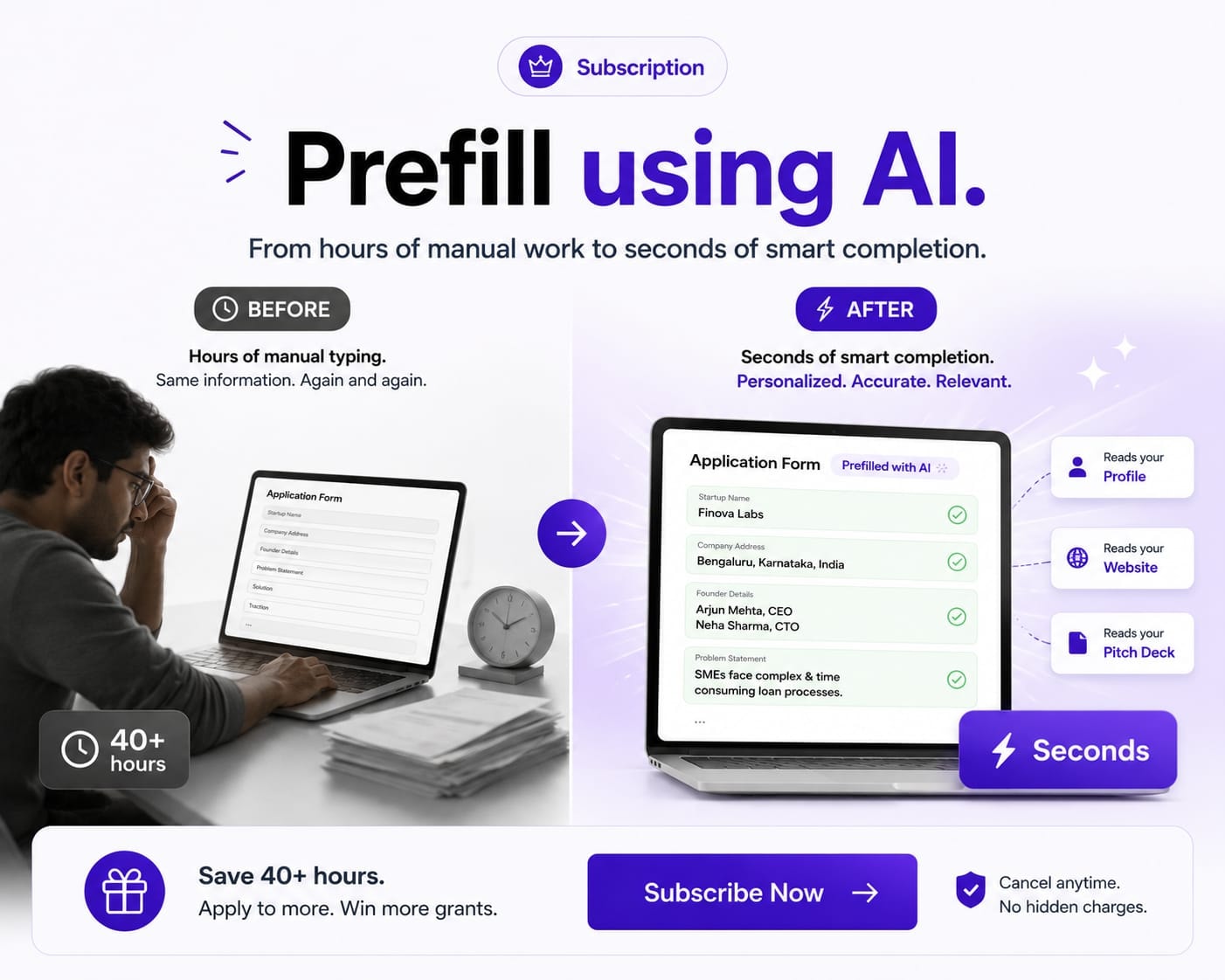
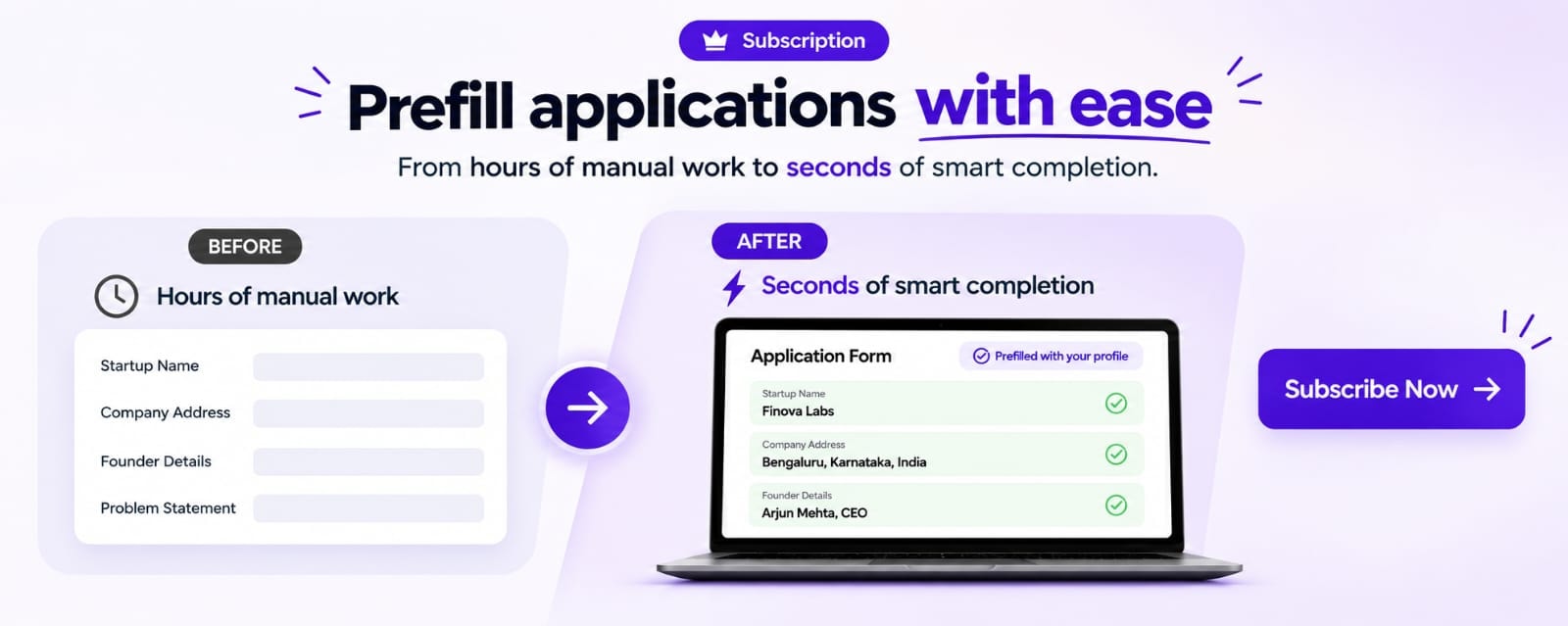
Answer the form inside the grant tracker — AI drafts each response using your past answers, so you're not starting from a blank page.
- 2
Submit on the official portal
Use the official application link and verify all details before final submission.
- 3
Follow up
Reach out 5–7 days after submitting to confirm receipt and ask about the review timeline.
Frequently Asked Questions
Can an Indian startup apply for the GSMA Innovation Fund for AI-Enabled Financial Health?
Only for a project outside India. India is not on the fund's list of eligible countries, so the project must run in an eligible country such as Nepal, Sri Lanka, Bhutan or Vietnam. For most countries you need not be headquartered there if you show how a local office or downstream partner will manage the work. For Bangladesh, Pakistan, Cambodia and other starred countries you must be registered and operating in that country.
Which countries are eligible for the GSMA AI financial health fund?
In South and South-East Asia: Bangladesh, Bhutan, Cambodia, Indonesia, Lao People's Democratic Republic, Malaysia, Maldives, Nepal, Pakistan, Philippines, Sri Lanka, Thailand, Timor-Leste and Vietnam. The list also includes 44 countries and territories in Africa, all named on the official FAQ page. A project can cover up to two of these countries.
Who can apply for the GSMA Innovation Fund?
For-profit, private-sector companies with up to 250 employees, including sole proprietorships, that have active users and some commercial revenue. Governments, non-profits, UN agencies, mobile operators, universities, accelerators and incubators cannot apply. Nor can organisations with an active GSMA grant.
How much funding does the GSMA Innovation Fund give?
You can ask for £100,000 to £250,000 (about ₹1.2 crore to ₹3 crore) for a project of 15 to 18 months. The grant covers project costs only, with no profit and no indirect costs, and overheads are capped at 10%.
How is the grant paid?
Over up to seven milestones, as reimbursement of eligible spending already made. The final 10% is paid when the grant closes, after a final audit that the GSMA pays for. You need a bank account that can receive pounds sterling.
Is matching funding required, and what counts?
Yes. You must bring at least 25% of the amount you request, secured and evidenced before the selection panel. It can be cash and in-kind, but in-kind alone is not enough, and it cannot come from other FCDO or GSMA funding.
Do I need revenue to apply?
Yes. The FAQs say you must have generated some commercial revenue to date, and a company with no revenue is not eligible. You will also need unqualified audited accounts before contracting, which usually means 9 to 12 months of recent financial history.
What is the deadline for the GSMA AI-Enabled Financial Health fund?
The eligibility form and application questionnaire must be submitted by 17 December 2026 at 23:59 UTC, which is 5:29 am on 18 December in India. Questions sent after 11 December 2026 will not be answered, so ask early.
Is it a grant or equity?
It is a grant made on a cost-only basis, and the official documents mention no equity or repayment. Applications must be written in English, and only one lead organisation applies: consortia are not accepted, though downstream partners are.
When are results announced?
A selection panel decides in August 2027, after evaluation from February to May 2027, a virtual pitch in May and an in-person visit between May and July. The whole process from application to contract takes about 10 months. Applicants who are not shortlisted do not receive feedback.
Sources
Data on this page is compiled from official program and provider references.