AMRUT 2.0 Startup Challenge 2026
By Ministry of Housing and Urban Affairs
Check your eligibility
Sign up and we'll tell you whether your startup qualifies for this grant.
Quick Answer
The AMRUT 2.0 India Pitch-Pilot-Scale Startup Challenge invites DPIIT-recognized startups to develop and pilot innovative technological and business solutions addressing critical urban challenges in water, air quality, energy efficiency, smart street lighting, and climate resilience, offering a grant of up to ₹20 lakh and opportunities for scaling.
- Funding amount
- Up to ₹20L
- Funding type
- Grant
- Application deadline
- 22d — 15 Dec 2026
- Location
- Open to startups registered in India
- Registrations needed
- DPIIT recognition
About this grant
The Ministry of Housing and Urban Affairs (MoHUA), Government of India, in collaboration with MyGov, has launched the AMRUT 2.0 India Pitch-Pilot-Scale Startup Challenge to harness India's vibrant startup ecosystem. This initiative aims to identify and promote breakthrough solutions for achieving the objectives of the Atal Mission for Rejuvenation and Urban Transformation 2.0 (AMRUT 2.0), particularly focusing on 'Water Secure Cities'. Beyond water and wastewater management, the challenge addresses a broader spectrum of interconnected urban issues including air quality, energy efficiency in municipal services, smart street lighting, and urban climate resilience and heat management.
The program encourages startups to "Pitch, Pilot, and Scale" their innovative solutions. It seeks to develop practical solutions for specific problem statements identified by Urban Local Bodies (ULBs) across Indian cities. By endorsing viable and environmentally friendly technologies, the challenge bridges the gap between innovators and beneficiaries, facilitating lab demonstrations and pilot tests in select cities, and ultimately supporting the wider adoption and scaling of successful solutions. This initiative also promotes the 'Make in India' movement by fostering Indian-origin startups and technological advancements, creating a robust ecosystem for urban innovation in the water and allied sectors.
The expanded scope of the challenge recognizes that urban challenges are multifaceted and often affect the same communities. It provides a platform for startups to directly engage with ULBs, understand ground-level problems, and co-create impactful solutions. This collaborative approach aims to accelerate the deployment of cutting-edge technologies that enhance the quality of urban life, improve municipal service delivery, and build more resilient and sustainable Indian cities.
Eligibility
See if you're eligible
Full eligibility criteria — entity type, stage, sector, founder profile and registration requirements — plus your fit for this program. Sign up to view.
Grant providers
Benefits & Funding
- Amount
- Up to ₹20L
- Fund type
- Grant
- Equity
- Equity-free
- Repayment
- Non-repayable
What You Get
Selected startups will receive a grant of up to ₹20 lakh, disbursed in three tranches (₹5 lakh, ₹7 lakh, and ₹8 lakh) upon achieving defined milestones in their project proposals. Beyond financial support, the challenge offers a unique opportunity to pilot solutions directly in AMRUT cities, facilitating direct engagement with Urban Local Bodies (ULBs) and opening pathways for wider adoption and scale across India. Participants will also benefit from mentorship support from experts and gain significant visibility and promotion from MoHUA for achieving desired outcomes, including a citation from the Ministry.
- Disbursement
- Tranched
- Bootstrap friendly
- Yes
Timelines & Process
Selection Process
The selection process involves a two-step screening. Initially, a Screening Committee conducts an initial shortlisting of submitted proposals. Subsequently, an Expert Committee scrutinizes these shortlisted proposals for final selection. Proposals are evaluated based on broad parameters including innovation, usability, relevance to the subject matter, societal impact, replicability, scalability, ease of deployment/roll-out, potential risks involved in implementation, and the completeness of the proposal.
Application Process
- 1
Register
Register for the challenge using a valid email ID on the official portal.
You - 2
- 3
- 4
- 5
- 6
How to apply
Four steps from draft to disbursement — one action each.
- 1
Draft your application
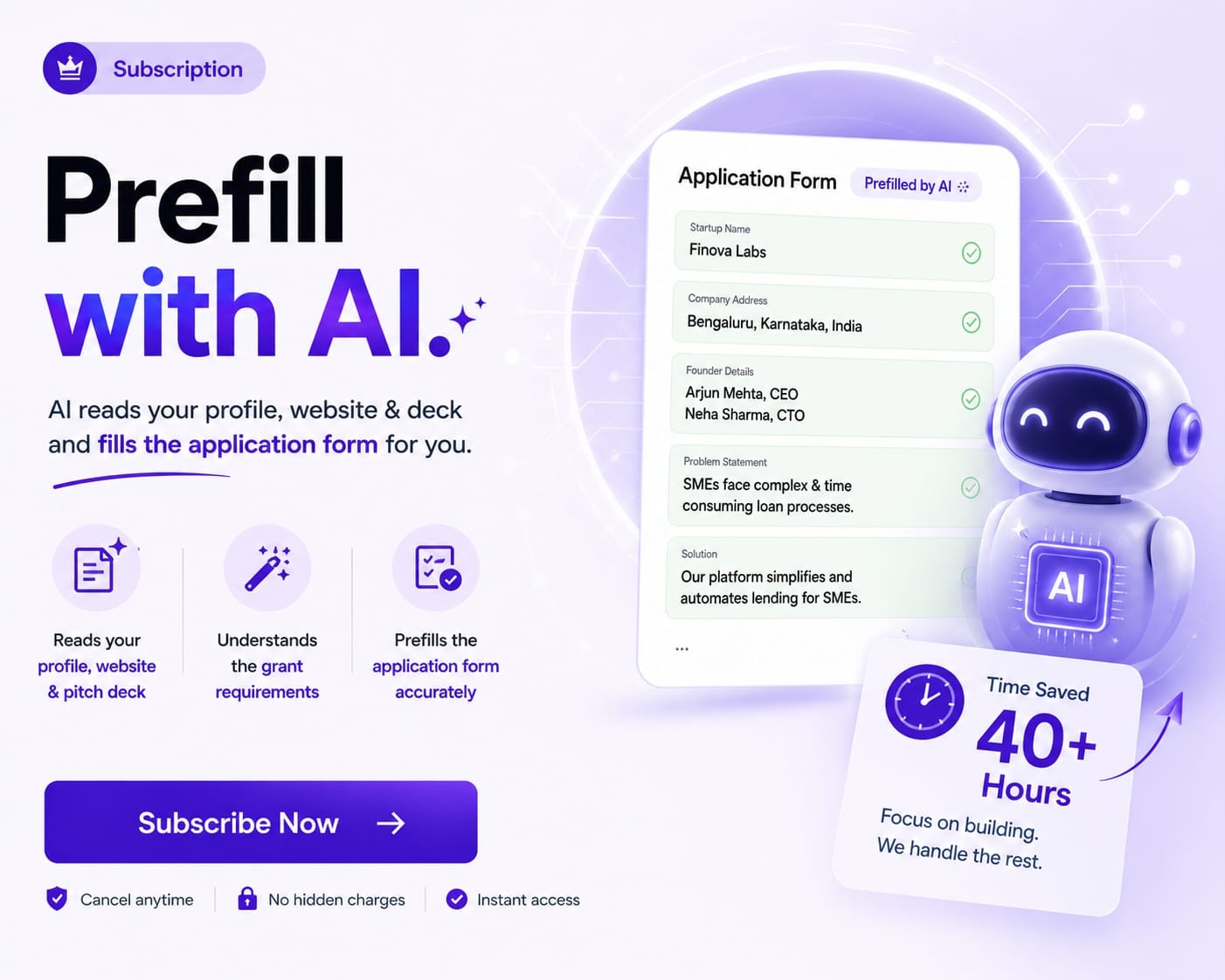
Answer the form inside the grant tracker — AI drafts each response using your past answers, so you're not starting from a blank page.
- 2
Submit on the official portal
Use the official application link and verify all details before final submission.
- 3
Follow up
Reach out 5–7 days after submitting to confirm receipt and ask about the review timeline.
Frequently Asked Questions
What kind of solutions is the challenge looking for?
The challenge is seeking innovative technological and business solutions to address critical urban challenges, particularly in water and wastewater management, but also including urban air quality, energy efficiency in municipal services, smart street lighting, and urban climate resilience and heat management.
Who is eligible to apply for this challenge?
Only entities recognized as startups by the Department for Promotion of Industry and Internal Trade (DPIIT) are eligible. Your solution must align with one of the twelve specified thematic areas.
What is the maximum grant amount available?
Selected startups are eligible for a grant of up to ₹20 lakh, which will be disbursed in three tranches based on the achievement of project milestones.
What kind of support, apart from funding, will be provided?
Beyond the grant, selected startups will receive mentorship, opportunities to pilot their solutions in AMRUT cities, direct engagement with Urban Local Bodies, and facilitation for scaling up their solutions in partnership with industries.
What is the application deadline for the challenge?
Applications for the AMRUT 2.0 India Pitch-Pilot-Scale Startup Challenge are open from November 10th, 2026, and must be submitted by December 15th, 2026.
What is the evaluation process for the proposals?
Proposals undergo a two-step screening process. An initial shortlisting is done by a Screening Committee, followed by a final scrutiny and selection by an Expert Committee based on criteria like innovation, usability, impact, replicability, scalability, and completeness.