Cities Deliver AI Grants 2026
Check your eligibility
Sign up and we'll tell you whether your startup qualifies for this grant.
Quick Answer
Grants of US$500,000 to US$2 million (about ₹4.75 crore to ₹19 crore) for organisations building AI tools with a city government. First round due 29 November 2026 ET.
- Funding amount
- Varies
- Funding type
- Grant
- Provider
- The Rockefeller Foundation
- Application deadline
- 23d — 30 Nov 2026
- Location
- International
About this grant
The Cities Deliver: AI Solutions for Public Services open call is a US$50 million programme from The Rockefeller Foundation and the OpenAI Foundation, managed by RF Catalytic Capital, an affiliate of The Rockefeller Foundation. It funds organisations that work hand in hand with a city government to use AI to improve public services, especially for underserved communities. The call is open now, with the first-round deadline at 11:59 pm Eastern Time on 29 November 2026 (about 10:29 am IST on 30 November).
Note early: only organisations can apply, and every project needs a city government partner. Individuals, independent researchers and consultants are excluded. The call is global, so an Indian organisation working with an Indian city can take part.
What the program offers
Grants run from US$500,000 (about ₹4.75 crore) to US$2 million (about ₹19 crore) over 24 months. Half is paid at the start and half after a documented mid-term milestone. Up to 50 partners will be selected. There are two tracks. Seed (US$500,000 to under US$1 million) is for an early concept that needs a first pilot in a city. Scale (US$1 million to US$2 million) is for a solution already piloted in a city with early results and ready to expand.
Besides money, partners join a peer learning cohort, get occasional AI product and engineering support, gain access to both foundations' networks of city leaders and funders, and are invited to a convening in 2027.
Projects must fall under one of four focus areas: public health (frontline care, disease surveillance, disability services, food access), economic mobility (benefits enrolment, career navigation, skills-based hiring), environmental resilience (emergency services, energy and grid infrastructure, land management) or civic engagement (two-way service channels, participatory decisions, digital access, courts and permitting, but not voting or elections).
Who can apply
Nonprofits can apply, including university departments or labs and fiscally sponsored organisations. Public benefit corporations and for-profit companies can apply only in limited circumstances: the project must be charitable, with no more than an incidental benefit to the company. The partner city must be a self-governing urban community of 50,000 or more people with its own municipal government, and the project needs a letter of intent from a city office or agency. The project must serve underserved, poor or distressed communities and include a meaningful AI component using recent generative AI models. Any AI platform is allowed; using OpenAI tools is not required. Research-only projects are not eligible, and neither are projects on elections, voter registration or lobbying. Organisations headquartered, registered or operating in a country under comprehensive US OFAC sanctions are excluded. Everything must be in English.
For India, this suits NGOs, social enterprises and university labs with an existing relationship with a municipal corporation. It does not suit a startup with no city partner, or a purely commercial product.
How to apply
Create an account on the Cities Deliver portal, then read the Overview and FAQs, the Terms and Conditions and the Round 1 questions. Complete the eligibility screening, get a letter of intent from your city partner (the foundation provides a template, or you can use an equivalent document), and submit the Round 1 proposal with proof of your legal status and a short video of your AI solution. The call opened on 14 October 2026, and questions were due by 31 October 2026. A practical tip: start the city letter early, because it depends on an official outside your organisation.
How applications are judged and what happens next
Round 1 proposals are judged on whether the problem is important for vulnerable communities, whether the city and residents genuinely want the solution, whether it is feasible with a real AI component, and whether the team is ready for public-sector work. Sustainability, handling of AI risks and a learning plan also count. Shortlisted teams have a 45-minute virtual interview in January 2027, invited teams send a fuller Round 2 proposal by 1 March 2027, and selections are expected in April 2027. AI tools help summarise applications, but people make the decisions.
About The Rockefeller Foundation and the OpenAI Foundation
The Rockefeller Foundation is a philanthropic organisation, and this call is a partnership with the OpenAI Foundation. RF Catalytic Capital, its affiliate, manages the call. The landing page itself gives little further background, so read the linked overview before applying.
Things to check before you apply
- The source does not say how foreign funds reach Indian recipients or in which currency they are paid. Indian organisations should check FCRA, FEMA and tax treatment with an adviser before applying.
- A for-profit has extra disclosure duties and may need to keep grant funds separate.
- The eligibility details above come from the programme documents summarised on the listing; the public landing page links to them rather than repeating them, so read the official Terms and Conditions yourself.
- Round 2 requires a budget, financial statements, team bios and an official letter or MOU from the city.
Eligibility
See if you're eligible
Full eligibility criteria — entity type, stage, sector, founder profile and registration requirements — plus your fit for this program. Sign up to view.
Grant providers
Benefits & Funding
- Fund type
- Grant
What You Get
Grants range from US$500,000 (about ₹4.75 crore) to US$2 million (about ₹19 crore). Seed projects get US$500,000 to under US$1 million for a first city pilot; Scale projects get US$1 million to US$2 million to expand a solution already piloted. Every grant runs 24 months: 50% is paid at the start and 50% after a documented mid-term milestone. The amount depends on the city's size and location, your organisation's size and maturity, how many people the project will reach and the track. Indirect costs are capped at 15% of the grant, and for-profit organisations cannot claim indirect costs.
- Disbursement
- Tranched
- Cohort size
- 50 startups
- Bootstrap friendly
- Yes
Timelines & Process
Selection Process
Round 1 proposals are judged on an important problem affecting vulnerable communities, credible demand from the city and residents, a feasible solution with a real AI component and a team ready for public-sector work, along with sustainability, AI risk handling and a learning plan. Shortlisted teams are interviewed in January 2027, invited teams submit a Round 2 proposal by 1 March 2027, and up to 50 partners are selected in April 2027. People make the final decisions.
Application Process
- 1
Eligibility screening
Confirm your organisation and project meet the basic rules.
You - 2
- 3
- 4
- 5
How to apply
Four steps from draft to disbursement — one action each.
- 1
Draft your application
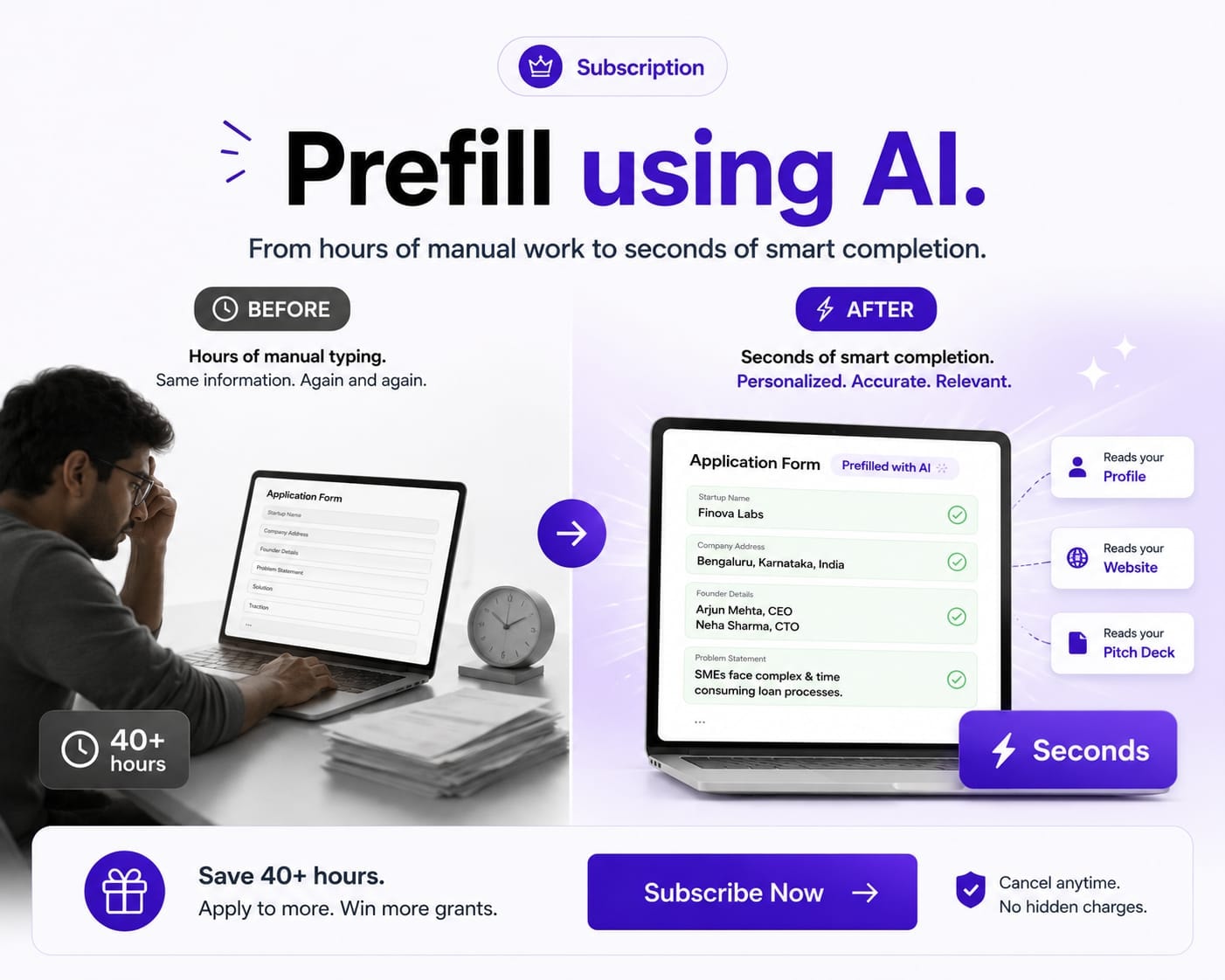
Answer the form inside the grant tracker — AI drafts each response using your past answers, so you're not starting from a blank page.
- 2
Submit on the official portal
Use the official application link and verify all details before final submission.
- 3
Follow up
Reach out 5–7 days after submitting to confirm receipt and ask about the review timeline.
Frequently Asked Questions
Who can apply for the Cities Deliver AI Grants?
Organisations that work in partnership with a city government can apply, mainly nonprofits including university labs and fiscally sponsored groups. Individuals, independent researchers and consultants cannot. The project must include a meaningful generative AI component and serve underserved communities.
Can Indian organisations apply for Cities Deliver?
Yes. The call is open to cities in all regions, including Asia, so an Indian organisation partnering with an Indian city of 50,000 or more people can apply. The only hard country exclusion is for organisations in countries under comprehensive US OFAC sanctions. Proposals must be in English.
How much is the Cities Deliver grant?
Grants range from US$500,000 (about ₹4.75 crore) to US$2 million (about ₹19 crore) over 24 months. The Seed track covers US$500,000 to under US$1 million, and the Scale track covers US$1 million to US$2 million. Up to 50 partners will be selected.
How is the Cities Deliver grant paid?
Half is paid at the start and half after a documented mid-term milestone. The landing page does not describe payment terms, so check the Terms and Conditions for the payout currency and how funds reach organisations outside the US.
What is the deadline for Cities Deliver, and what if it has passed?
The first round, with the eligibility screening, Round 1 proposal and video, is due at 11:59 pm Eastern Time on 29 November 2026, which is about 10:29 am IST on 30 November. The source does not mention another intake, so a missed deadline means watching for any future round.
Is Cities Deliver a grant or equity?
It is a grant, not an investment. The source describes no equity being taken. For-profit companies can apply only if the project is charitable and gives the company no more than an incidental benefit.
Do we need a city partner before applying?
Yes. Every project needs a city or municipal government partner, and the Round 1 proposal needs a letter of intent from a city office or agency. The foundation offers a template for that letter. Get this started early because it depends on someone outside your organisation.
What documents are needed for Cities Deliver?
Round 1 needs the eligibility screening, the proposal, proof of your organisation's legal status, the city's letter of intent and a short video of your AI solution. Invited teams later send a budget, financial statements, team bios and an official letter or MOU from the city for Round 2.
Do we have to use OpenAI tools or travel?
No. The call is platform agnostic and has no preference for any AI platform. Interviews are virtual. The source mentions an invitation to a convening in 2027 but does not say whether travel costs are covered.
Is it free to apply, and when are results announced?
The source does not state an application fee, so check the portal. Shortlisted teams are interviewed in January 2027, Round 2 proposals are due 1 March 2027, and up to 50 partners are selected in April 2027.
Sources
Data on this page is compiled from official program and provider references.