Docusign Agreements for Good Grants
Check your eligibility
Sign up and we'll tell you whether your startup qualifies for this grant.
Quick Answer
Docusign Foundation grants of US$20,000–100,000 (about ₹19–95 lakh), or up to US$200,000 a year, for non-profit-led partnerships building shared agreements. No fixed deadline.
- Funding amount
- Varies
- Funding type
- Grant
- Provider
- Docusign Foundation
- Application deadline
- Rolling
- Location
- International
About this grant
Agreements for Good is a core grant program of the Docusign Foundation. It funds collaborations between organisations that need to agree how they will work together on a hard problem. One-time grants of US$20,000–100,000 (about ₹19 lakh to ₹95 lakh) are listed for new partnerships, and multi-year grants of up to US$200,000 a year (about ₹1.9 crore a year) for established ones. The page states no deadline, and applications are open worldwide through an online alignment check.
The lead applicant must be a registered non-profit, charity or NGO, or a fiscally sponsored project. This is therefore a program for Indian NGOs and non-profit-led coalitions, not for a for-profit startup on its own. Businesses can be partners but cannot lead or receive the grant.
What the program offers
The official page describes two kinds of grant: one-time grants that launch new partnerships, and multi-year grants for established collaborations that need to endure. According to this listing, one-time grants run from US$20,000 to US$100,000 for at least two organisations, and multi-year grants run for up to two years at up to US$200,000 a year for at least three organisations already collaborating formally. The page itself does not publish grant sizes; the amounts come from the listing record.
Money can pay for convening, facilitation, agreement design, prototype partnerships, backbone coordination, shared tools, studies and communications. The listing records that indirect costs are not covered. The program states a clear aim: to invest in agreements that bring people together, build trust and create lasting change.
Who can apply
The lead organisation must be an eligible entity, such as a 501(c)(3) or its global equivalent, a registered non-profit, charity or NGO, or a fiscally sponsored project. A state, tribal or local government body may act as the backbone organisation. One-time grants need at least two organisations; multi-year grants need at least three in formal collaboration. Cross-sector partnerships are encouraged. Applications are accepted globally, at local and global levels.
The work must fit one of three areas: environment and sustainability, data privacy and security, or the future of work. The page lists what is not funded: work outside these priorities, projects that do not use a collaborative or coalition model, projects with no agreement-building component, political activity and lobbying, individuals, for-profit businesses, religious or discriminatory organisations, and fundraising events. The listing adds that regranting intermediaries, single-organisation programs and learning networks without an agreement-building aim are not eligible.
For an Indian applicant, this suits a registered NGO or trust that leads a coalition and wants to formalise shared rules or governance. It does not suit a single organisation, an individual founder, or a startup that wants to be the grant recipient. Indian NGOs receiving foreign money should check FCRA, FEMA and tax treatment with an adviser before applying.
How to apply
Start with the alignment check, a short online form linked on the official page. If your collaboration is a fit, Docusign sends instructions for submitting a full application. The page also links an application FAQ document. The listing notes that you apply either as a new or an established collaboration and request the amount your agreement work needs. The source page does not state the language of the application, the documents required or the format of the full application, because those come after the alignment check.
A practical tip: before you fill in the alignment check, write one clear sentence describing the agreement your partners want to reach, such as shared governance, data standards or a formal commitment, and who has a voice in decisions.
How applications are judged and what happens next
The page does not list formal scoring criteria, but it describes signs of success: communities most affected have a voice and power in decisions, partners formalise their agreements, and trust grows so that the agreements outlast one project or funding cycle. The listing says full applications are reviewed for a clear agreement the partners aim to reach, why it is achievable in the timeline, shared decision-making among partners and a learning mindset. The page does not give a timeline for decisions or results.
About the Docusign Foundation
The Docusign Foundation is the philanthropic arm linked to Docusign, whose business is agreements. Agreements for Good is one of its core programs, and the page points to an annual impact report for more on its results. The page gives little further background.
Things to check before you apply
- There is no published deadline, so confirm timing when you receive the application instructions.
- Grant sizes, indirect-cost exclusions and the two-year limit come from the listing, not the short official page, so confirm them in the application guidance.
- The source does not say whether grants are paid in US dollars or how they are paid.
- You need genuine partners, not a single organisation using partners as a formality.
- It is not stated whether there is any entry fee; the alignment check form does not suggest one.
Eligibility
See if you're eligible
Full eligibility criteria — entity type, stage, sector, founder profile and registration requirements — plus your fit for this program. Sign up to view.
Grant providers
Benefits & Funding
- Fund type
- Grant
- Equity
- Equity-free
- Repayment
- Non-repayable
What You Get
New partnerships can get a one-time grant of US$20,000–100,000 (about ₹19 lakh to ₹95 lakh). Established collaborations of three or more organisations can get a multi-year grant for up to two years, of up to US$200,000 (about ₹1.9 crore) a year. Funds cover collaboration costs such as facilitation, convenings, backbone coordination, shared tools, research and communications, including staff time tied to that work; indirect costs are not covered.
- Bootstrap friendly
- Yes
Timelines & Process
Applications
Rolling basis
Selection Process
Docusign first checks whether your collaboration is a fit through the online alignment check. Fitting collaborations are then told how to submit a full application, which the listing says is reviewed for a clear target agreement, why it is achievable in the timeline, shared decision-making and a learning mindset. The official page gives no decision timeline.
Application Process
- 1
Alignment check
Complete the online alignment check.
You - 2
- 3
- 4
How to apply
Four steps from draft to disbursement — one action each.
- 1
Draft your application
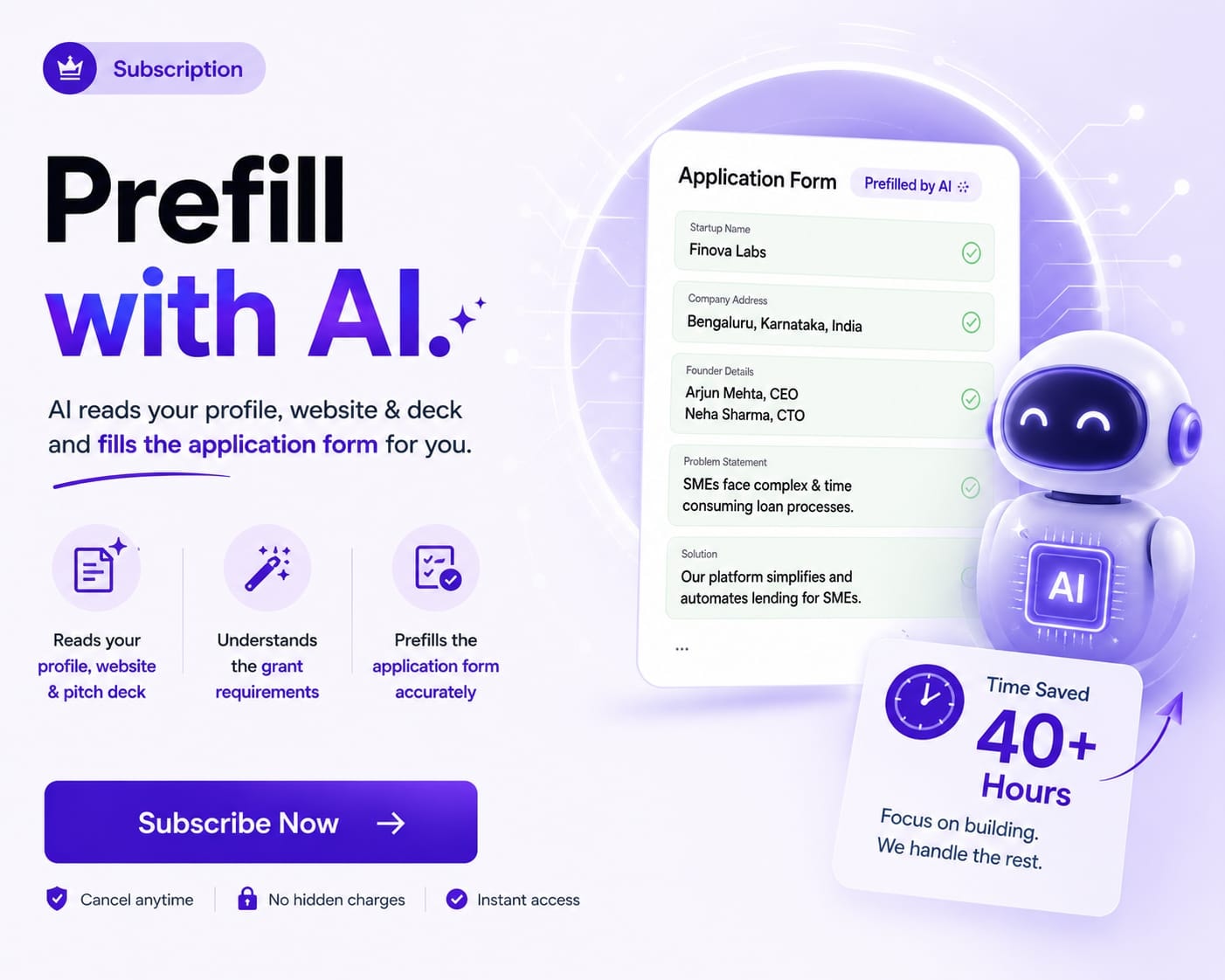
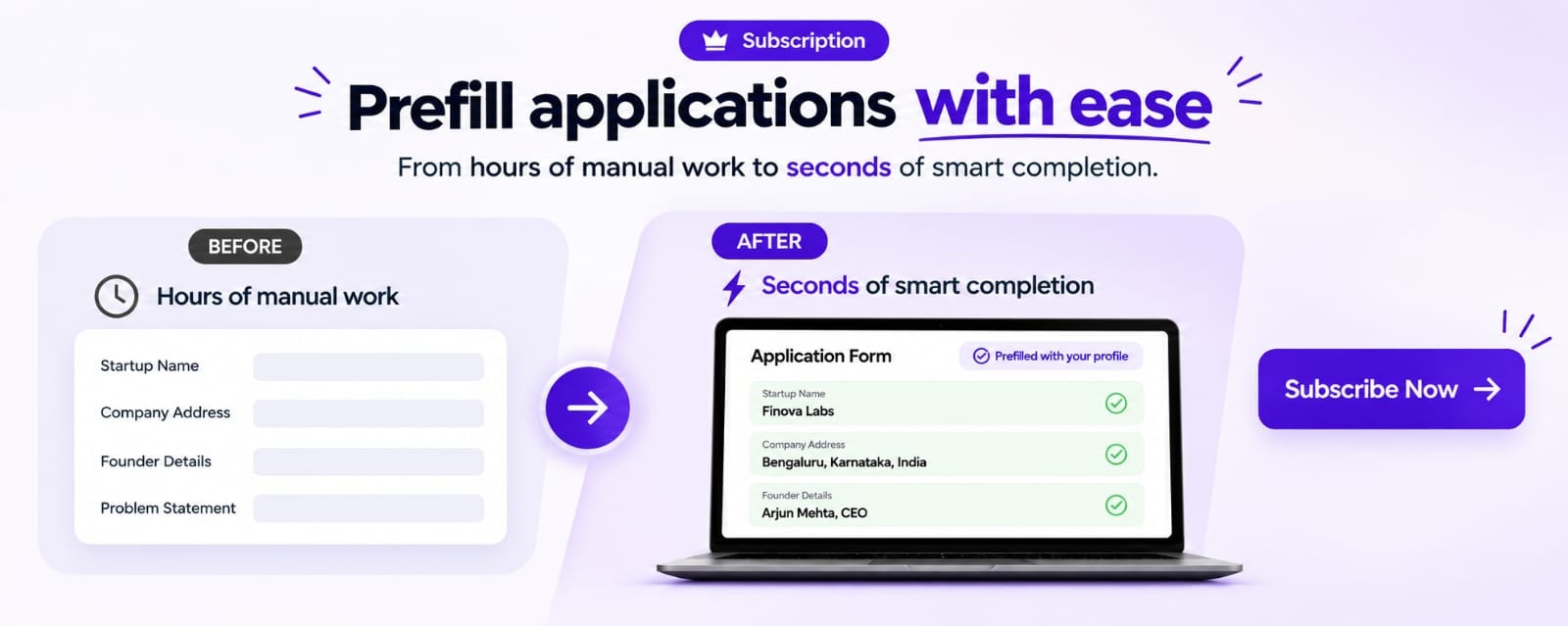
Answer the form inside the grant tracker — AI drafts each response using your past answers, so you're not starting from a blank page.
- 2
Submit on the official portal
Use the official application link and verify all details before final submission.
- 3
Follow up
Reach out 5–7 days after submitting to confirm receipt and ask about the review timeline.
Frequently Asked Questions
Who can apply for the Docusign Agreements for Good grant?
The lead organisation must be a registered non-profit, charity or NGO, a 501(c)(3) or global equivalent, or a fiscally sponsored project. One-time grants need at least two organisations, and multi-year grants need at least three in formal collaboration. Individuals and for-profit businesses are not funded.
Can Indian NGOs apply for Docusign Agreements for Good?
Yes, the page says applications are accepted globally, so a registered Indian NGO or trust leading a collaboration can start with the alignment check. A startup cannot lead or receive the grant. Indian NGOs receiving foreign money should check FCRA, FEMA and tax treatment with an adviser before applying.
How much is the Docusign Agreements for Good grant?
The listing records one-time grants of US$20,000–100,000 (about ₹19 lakh to ₹95 lakh) and multi-year grants of up to US$200,000 a year (about ₹1.9 crore a year) for up to two years. The short official page does not publish amounts, so confirm them in the application guidance.
How is the Agreements for Good grant paid?
The source does not say how or when the grant is paid or in which currency. The listing notes that money can cover facilitation, convening, backbone coordination, shared tools, studies and communications, but not indirect costs. Ask for the payment terms when you receive the full application instructions.
What is the deadline for Docusign Agreements for Good, and what if it has passed?
The official page does not publish a deadline. The program starts with an online alignment check, and eligible collaborations are then told how to apply. Because no date is stated, check the page directly for the latest position.
Is Docusign Agreements for Good a grant or equity?
It is a grant to non-profit-led collaborations. The source describes no equity or ownership being taken. For-profit businesses can be partners but cannot lead or receive the grant.
What documents do I need for the Docusign Foundation grant?
The page does not list documents. You begin with an online alignment check, and eligible collaborations then receive instructions for the full application. A separate application FAQ document is linked on the page.
Do I have to travel for Docusign Agreements for Good?
The source does not mention any travel requirement. The grants fund collaborations, which can include convening and facilitation. Ask about any in-person expectations during the full application.
Is it free to apply for the Docusign Foundation grant?
The source does not state an entry fee. The alignment check is an online form, and nothing on the page asks for payment. Check the application guidance if in doubt.
When are Docusign Agreements for Good grant decisions announced?
The source gives no decision date or timeline. After the alignment check, eligible collaborations are told how to apply. Ask Docusign for the expected timeline when you receive the instructions.
Sources
Data on this page is compiled from official program and provider references.