Research Software Catalyst Fund 2026
By Research Software Catalyst Fund
Check your eligibility
Sign up and we'll tell you whether your startup qualifies for this grant.
Quick Answer
Exploratory grants of up to US$50,000 (about ₹47.5 lakh) for open tools and practices that make AI-assisted research software trustworthy. Apply by 31 December 2026.
- Funding amount
- Varies
- Funding type
- Grant
- Provider
- Research Software Catalyst Fund
- Application deadline
- 54d — 31 Dec 2026
- Location
- International
About this grant
The Research Software Catalyst Fund 2026 is a grants program that backs people building, checking and teaching research software, and the tools, methods and training the community needs to use generative AI well. The current call offers exploratory grants of up to US$50,000 (about ₹47.5 lakh) for work lasting three to six months, and applications close on 31 December 2026.
What the program offers
Each exploratory grant can go up to US$50,000 (about ₹47.5 lakh), and most are expected to fall between US$15,000 and US$50,000. The grant is for a project that can start now and finish within three to six months. The fund gives examples of the kind of work it has in mind: agent-based tools that help with software testing and review, agent workflows that take on routine maintenance such as sorting issues and updating dependencies, collections of case studies, and playbooks for research teams that are adopting AI.
The fund is hosted at Hack Club Bank, which can pay individuals and unincorporated groups as well as institutions, and it can make international payments. A larger impact track with awards of up to US$200,000 is planned for 2027, but it is not open yet.
Who can apply
Individuals, informal teams, institutions and non-profits can apply from anywhere in the world. You do not need an institutional affiliation. People and organisations in countries or regions under comprehensive US sanctions cannot be funded. The work must advance the practice of producing trustworthy research software with AI. Work that mainly benefits a private company or individual, and policy or advocacy work, is not funded.
For an applicant in India this means you can apply as an individual, a small team, a university group or a non-profit. It suits research software engineers, open source maintainers and academic teams who can deliver something concrete in six months. It is not a fit for a startup that wants money for a commercial product, or for a long multi-year programme.
How to apply
Read the guidelines and examples on the fund's website first. Then write a proposal of up to five pages in plain language. It should explain what you will do and produce, who is involved, a simple budget, a schedule of three to six months, and how the work connects to the community's priorities. Submit it through the online form before the deadline. A practical tip: name one specific output you will release, because reviewers look for a concrete, openly licensed result.
Everything the fund pays for must be released openly. Software goes under an OSI-approved licence, and documents, curricula, playbooks and data go under CC BY or CC0 and are hosted publicly.
How applications are judged and what happens next
A panel of five to seven community reviewers, none of whom are applicants in this round, reads every proposal. They look at whether you can start now and finish within six months, whether there is a concrete openly licensed output, how relevant it is to trustworthy AI-assisted research software, who benefits beyond the applicants, and whether the budget matches the work. Decisions are yes, no, or a request to revise.
Proposals are read from January to March 2027 and applicants hear back by mid-March 2027. The fund does not give individual feedback. If you are funded, you complete paperwork and receive the money through Hack Club Bank.
About the Catalyst Fund
The fund's money comes from US charitable foundations, and it is fiscally sponsored by The Hack Foundation, the non-profit behind Hack Club. Fiscal sponsorship means the fund can accept and pay out money under that non-profit's legal umbrella.
Things to check before you apply
- The source describes this as an exploratory round. Check the guidelines for what is and is not covered, especially indirect costs, which are counted inside the US$50,000 limit.
- Your outputs must be openly licensed, so this does not suit work you need to keep proprietary.
- Payments are made in US dollars through a US host, so as a recipient in India check the tax and foreign-exchange treatment with an adviser.
- Payments cannot be made where US sanctions law prevents them.
Eligibility
See if you're eligible
Full eligibility criteria — entity type, stage, sector, founder profile and registration requirements — plus your fit for this program. Sign up to view.
Grant providers
Benefits & Funding
- Fund type
- Grant
What You Get
Selected projects receive up to US$50,000 (about ₹47.5 lakh), including up to 10% for overheads, for three to six months of work. Travel to bring a distributed team together for a sprint or workshop can be included. Funds are released through Hack Club Bank once the paperwork is complete, and at the end you share a public output and a short note on what you learned.
- Bootstrap friendly
- Yes
Timelines & Process
Selection Process
A panel of five to seven community reviewers who are not applicants in the round reads every proposal between January and March 2027. They weigh readiness to start and finish within six months, a concrete openly licensed output, relevance to trustworthy AI-assisted research software, who benefits beyond the applicants, and whether the budget fits the work. Decisions are yes, no or a request to revise, with replies by mid-March 2027.
Application Process
- 1
Submit proposal
Send a five-page proposal with budget and schedule by 31 December 2026.
You - 2
- 3
- 4
How to apply
Four steps from draft to disbursement — one action each.
- 1
Draft your application
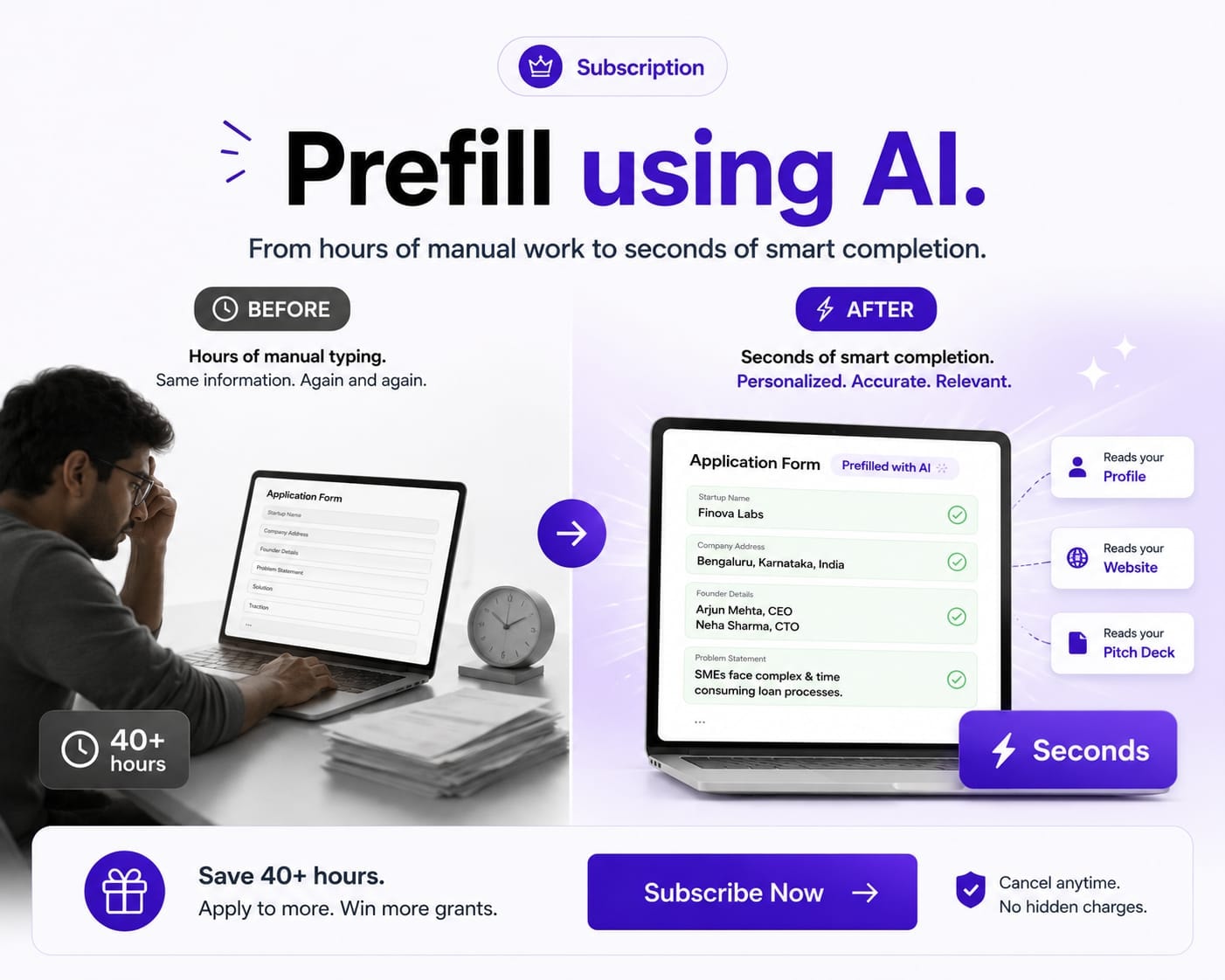
Answer the form inside the grant tracker — AI drafts each response using your past answers, so you're not starting from a blank page.
- 2
Submit on the official portal
Use the official application link and verify all details before final submission.
- 3
Follow up
Reach out 5–7 days after submitting to confirm receipt and ask about the review timeline.
Frequently Asked Questions
Who can apply for the Research Software Catalyst Fund?
Individuals, informal teams, institutions and non-profits can apply. No institutional affiliation is needed. The work must advance trustworthy, AI-assisted research software and be released openly.
Can Indian researchers and developers apply for the Research Software Catalyst Fund?
Yes. The fund accepts applications from anywhere in the world and can make international payments, except where US sanctions law prevents a payment. India is not named as excluded.
How much funding can I get from the Research Software Catalyst Fund?
Exploratory grants go up to US$50,000 (about ₹47.5 lakh), and most are expected to be between US$15,000 and US$50,000. The amount should match what the work costs, including indirect costs.
How is the Catalyst Fund grant paid?
The fund is hosted at Hack Club Bank, which can pay individuals and unincorporated groups as well as institutions. After you are funded you complete paperwork and receive the money there. The source does not say how many instalments there are.
What is the deadline for the Research Software Catalyst Fund, and what if it has passed?
Applications close on 31 December 2026. The source says a larger impact track with awards up to US$200,000 is planned for 2027, but it does not promise another exploratory round, so check the website if you miss this one.
Is the Research Software Catalyst Fund a grant or equity?
It is a grant. The source mentions no equity or ownership being taken. In return, everything funded must be released openly under the licences the fund names.
What documents do I need for the Catalyst Fund application?
A proposal of up to five pages in plain language, with what you will do and produce, who is involved, a simple budget, a schedule of three to six months and how it links to community priorities. The source does not list further documents.
Do I need to travel for the Research Software Catalyst Fund?
The source mentions no travel. The program is run online and paid through Hack Club Bank.
Is it free to apply to the Research Software Catalyst Fund?
The source does not mention an application fee.
When will I hear the results of the Catalyst Fund round?
Reviewers read proposals from January to March 2027 and applicants are told by mid-March 2027. Individual feedback is not provided.
Sources
Data on this page is compiled from official program and provider references.